NVIDIA and partners advance AI training for warehouse robots
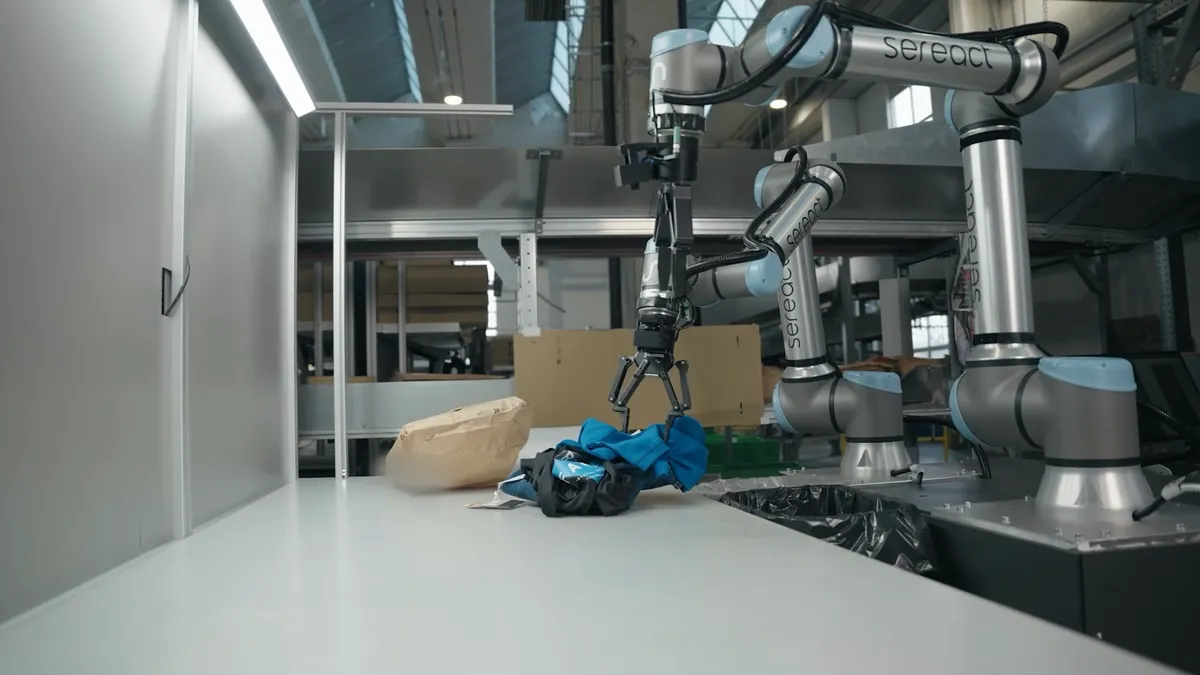
Sereact, NVIDIA, Nebius, CEVA Logistics and Zalando have announced a new artificial intelligence training framework designed to improve robotic handling of returned products in e-commerce fulfilment operations.
The collaboration introduces a closed-loop training process for Cortex, Sereact’s robotic AI system, combining operational data from warehouse robots with simulation, model training and performance evaluation. The initial deployment focuses on Zalando’s returns operations at selected fulfilment centres managed by CEVA Logistics.
According to the companies, the framework is designed to reduce the time required to improve robotic performance from weeks to days by connecting real-world warehouse activity with automated simulation and retraining processes.
The initiative builds on the use of robotic systems in e-commerce returns handling, where products can arrive in different conditions and packaging configurations, making automated processing particularly challenging.
Connecting warehouse operations with AI simulation
Returns processing presents a complex environment for warehouse automation because individual items can differ significantly in their physical condition and presentation.
Clothing may arrive folded, crumpled, packaged or unpackaged, while labels and tags may be missing or positioned differently. Robots must handle these variations while identifying, inspecting and sorting products across frequently changing assortments.
Sereact’s Cortex system learns from real-world robotic operations, but conventional training methods depend heavily on the examples encountered during warehouse activity. Previously, improving performance required collecting operational data, retraining the system and testing updated software on physical robots, with each cycle potentially taking several weeks.
The new framework connects these stages through a shared data environment operated by Nebius.
Video recordings and robotic movement data collected at returns stations are stored in Nebius’s infrastructure. NVIDIA Isaac Lab then uses these records to generate thousands of simulated variations, while NVIDIA Cosmos world foundation models create additional representations involving different garment conditions, packaging materials and lighting environments.
The resulting datasets are used to further train Cortex on NVIDIA Blackwell GPUs, allowing the system to encounter a broader range of scenarios than those recorded during actual warehouse operations.
Updated robotic policies are subsequently evaluated against predefined performance criteria before progressing to real-world testing.
If a policy fails to meet the required threshold, the framework generates additional training scenarios targeting the weaknesses identified during evaluation.
Automated training supported by NVIDIA and Nebius
The collaboration brings together several technologies within a coordinated training and evaluation workflow.
NVIDIA provides Isaac Sim and Isaac Lab for simulation, Cosmos models for generating additional training scenarios, and its Physical AI Data Factory skills, which enable AI agents to coordinate different stages of the process.
Nebius supplies the Physical AI Workbench, an open-source framework that connects simulation, training, evaluation and data management. The infrastructure operates through the company’s European Union data centres, using RTX-class GPUs for simulation and NVIDIA Blackwell GPUs for training.
Sereact contributes Cortex, its vision-language-action model, together with dual-arm robotic returns stations and operational data collected during warehouse processing.
CEVA Logistics provides the fulfilment environment in which the robotic systems are deployed, while Zalando supplies the returns-handling use case against which updated robotic capabilities are evaluated.
An AI agent coordinates the training workflow, including estimating computing costs, launching processing stages and checking whether updated policies meet the required performance thresholds.
Sereact engineers define training objectives and retain approval authority for runs exceeding established cost limits.
The approach is intended to reduce the amount of manual coordination required between data collection, simulation, model training and evaluation.
Initial rollout focuses on Zalando returns
The initial application targets Zalando’s returns-handling operations at selected CEVA Logistics fulfilment centres, where robotic systems must process products with varying shapes, materials and packaging conditions.
The framework is designed to support repeated improvements as new product assortments and handling challenges emerge. Rather than relying exclusively on physical testing, the companies can use simulated scenarios to evaluate updated robotic behaviour before introducing changes into operational environments.
However, updated policies are not deployed solely on the basis of simulated training. They must first meet Sereact’s evaluation criteria and subsequently undergo real-world testing at the returns stations.
Beyond the initial collaboration, the closed-loop training pipeline is available as a reference architecture through Nebius Physical AI Workbench.
The framework includes NVIDIA Physical AI Data Factory skills and is accessible to robotics teams using Nebius AI cloud infrastructure in European Union regions. According to the announcement, customers are charged for the computing and storage resources they consume.
The collaboration represents a further development in the application of physical AI to warehouse automation, with the participating companies focusing on shortening the process of improving robotic capabilities in complex e-commerce logistics environments.