Europe’s port transformation: Can innovation keep pace with investment needs?
The launch of a new European innovation platform highlights a broader challenge for ports: turning technological progress and environmental ambitions into financially viable infrastructure projects.
European ports are entering a period in which technological innovation, environmental requirements and infrastructure investment are becoming increasingly interconnected. Port authorities are being asked to support cleaner maritime transport, accommodate new energy systems and modernise operations while maintaining the efficiency and competitiveness of their facilities.
The latest development is the availability of the Green Innovation Compass, a knowledge platform presented by the European Sea Ports Organisation (ESPO) and the European Federation of Inland Ports (EFIP) on 14 October. Developed as a legacy of the EU-funded MAGPIE project, the platform brings together practical knowledge on technologies and operational solutions intended to support the green and digital transformation of maritime and inland ports.
Its introduction comes at a time when European ports face substantial investment requirements. According to ESPO’s Port Investments Study 2024, the investment needs of European port managing bodies were estimated at approximately €80 billion over the decade to 2034.
Taken together, these developments raise an important question: can the availability of innovative solutions translate into infrastructure investment at the scale required across Europe’s diverse port network?
Innovation is only part of the transformation
The Green Innovation Compass is designed to make technical knowledge and practical experience more accessible to port authorities and other stakeholders. It draws on work undertaken through MAGPIE, which brought together ports, companies, research institutions and public authorities to explore more sustainable and efficient port operations.
The initiative addresses an important aspect of infrastructure development. Ports considering new technologies need information about their potential applications, operational requirements and relevance to different facilities. Access to shared knowledge may help authorities evaluate solutions without relying exclusively on their own experience or the claims of individual technology providers.
However, access to information does not necessarily translate into investment. A technology that appears suitable in one port may face different economic, operational or infrastructure conditions elsewhere. Electricity supply, terminal configuration, vessel traffic, available land and existing transport connections can all influence the feasibility of a project.
The distinction is particularly relevant for smaller ports, which may have fewer technical and financial resources available to assess complex investments. While shared knowledge can support decision-making, implementation still depends on project preparation, financing and the ability to integrate new systems into existing operations.
The Green Innovation Compass therefore represents a resource for evaluating possible solutions rather than a financing mechanism or evidence that the technologies presented have achieved commercial viability across the European port sector.
The scale of Europe’s investment requirements
The financial dimension of port transformation is substantial. ESPO’s Port Investments Study 2024, based on an assessment of 84 port managing bodies, estimated investment needs of approximately €80 billion through 2034.
The figure relates to the investment requirements identified for port managing bodies. It should not be interpreted as the total cost of every public and private investment associated with European ports, nor as funding that has already been committed.
The study also identified sustainability and the energy transition as the second-largest category of investment requirements for port authorities. This reflects the expanding role of ports beyond their traditional responsibilities for maritime access, cargo handling infrastructure and connectivity.
ESPO has also highlighted a structural difficulty in financing port development: certain investments can deliver substantial public and societal benefits without generating equally strong or immediate financial returns for the port authorities undertaking them. Their economic value may extend beyond the revenues directly captured by the organisations responsible for the infrastructure.
This creates an important distinction between commercially driven investments and projects designed to meet environmental or broader public-policy objectives. While improvements associated with cargo growth or terminal productivity may offer identifiable revenue opportunities, other investments can involve longer repayment periods or less predictable financial returns.
Consequently, the central investment question is not simply whether new technologies exist. It is also how different types of projects can be financed, which organisations should bear their costs and how their benefits should be assessed.
Environmental progress and infrastructure constraints
The ESPO Environmental Report 2026, published on 8 October, provides another perspective on the transformation underway. Drawing on environmental information from 73 European ports across 17 countries, the report documents the environmental priorities and activities of participating ports.
According to the report, 85% of participating ports have established greenhouse gas emissions reduction targets, while 60% report having onshore power supply infrastructure. These findings indicate progress among the ports included in the survey, although they should not be interpreted as representative of every European port.
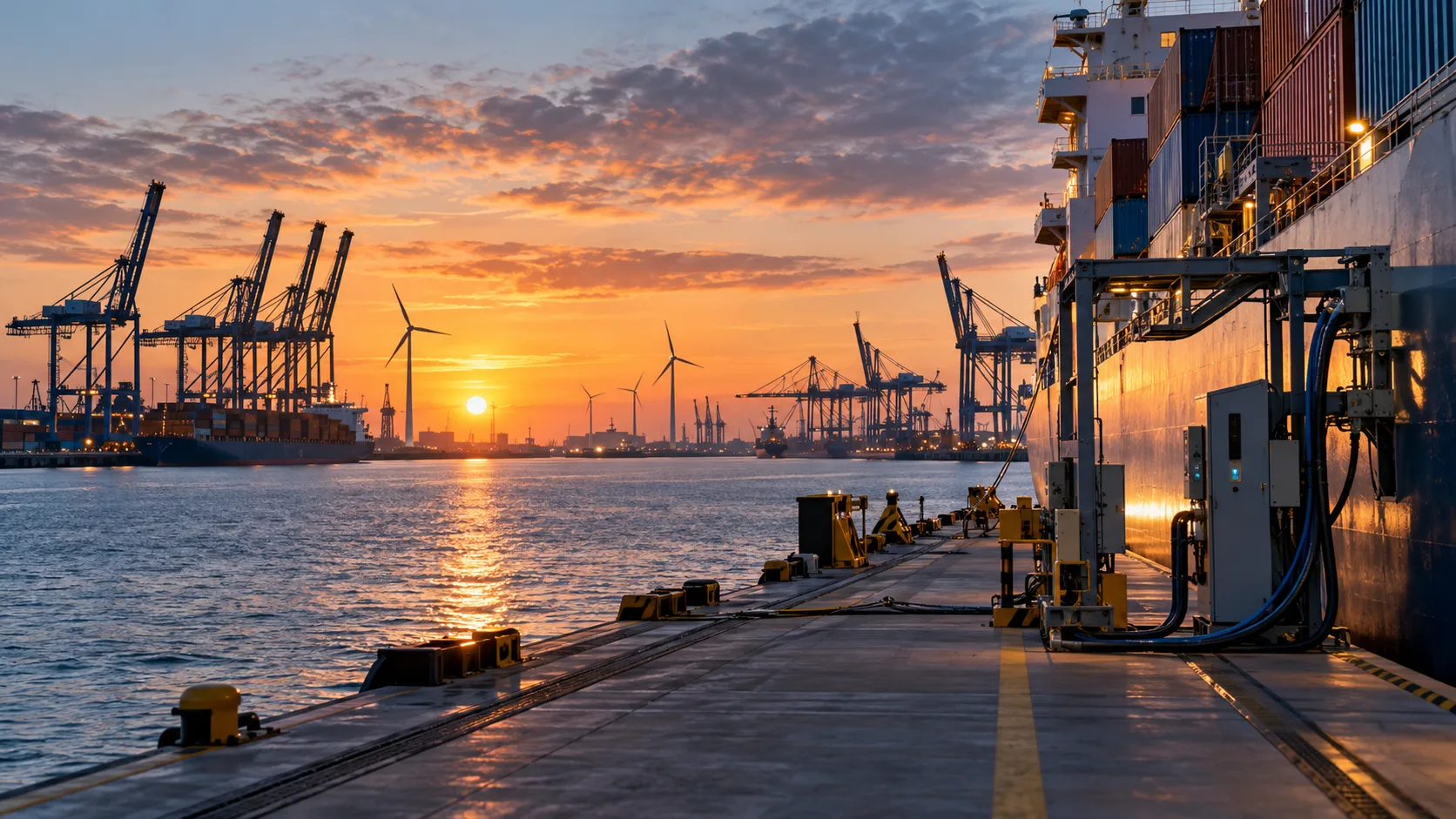
Onshore power supply allows suitably equipped vessels to receive electricity while berthed instead of relying entirely on onboard generation. Such systems can help reduce emissions during port stays, but their implementation involves more than installing equipment along a quay.
The report also identifies electricity grid capacity and connectivity as important challenges. Power availability, grid connections, equipment compatibility and the expected use of infrastructure all influence project planning. Investment decisions may therefore depend on cooperation among port authorities, electricity network operators, terminal operators, shipping companies and public institutions.
These dependencies illustrate why technological availability and infrastructure readiness should be assessed separately. A port may identify an appropriate solution but still face constraints involving grid capacity, project costs or the coordination required to bring the system into operation.
The same broader principle applies to other aspects of port modernisation. Digital systems, energy infrastructure and operational technologies must function within established commercial and physical networks. Their value depends partly on the surrounding infrastructure and the organisations required to use them.
European policy meets local investment decisions
The European Commission’s EU Ports Strategy, adopted on 4 March 2026, places competitiveness, security, sustainability and resilience at the centre of its approach to the sector.
The strategy recognises that ports are increasingly expected to serve multiple functions. Alongside facilitating trade and passenger transport, they are becoming important locations for energy infrastructure, industrial activity and wider supply-chain development.
The Commission has also identified access to finance and investment as a policy priority, including measures intended to improve coordination, advisory support and access to financial instruments.
On 12 March 2026, the European Commission and the European Investment Bank announced an advisory and capacity-building initiative under the JASPERS framework, intended to help small and medium-sized ports within the Trans-European Transport Network prepare and develop investment projects.
The initiative focuses on strengthening technical expertise and project preparation, including the development of financially and technically sound proposals. It should not be confused with a dedicated programme providing automatic or direct financing for port infrastructure.
This addresses a different problem from the one targeted by the Green Innovation Compass. The Compass supports access to knowledge about possible innovations, while advisory programmes focus on the preparation and development of investable projects.
Neither initiative, by itself, guarantees that a proposed investment will receive funding or proceed to construction.
The distinction between policy ambition and implementation is important because European ports operate under different ownership structures, commercial conditions and national investment frameworks. A solution appropriate for a large industrial port may not be financially or operationally justified at a smaller regional facility.
A coordinated European strategy can establish common priorities, but individual projects still require local assessment of costs, demand, infrastructure constraints and financing arrangements.
Can innovation and investment advance together?
The emergence of the Green Innovation Compass alongside the EU Ports Strategy and ESPO’s latest environmental reporting illustrates how several elements of European port transformation are developing simultaneously.
There is a growing body of technical knowledge, a clearer European policy framework and documented investment requirements. What these developments do not establish is whether financing and implementation capacity are sufficient to deliver every proposed project within the desired timeframe.
The challenge is therefore broader than accelerating the adoption of new technology. It involves identifying where innovation offers measurable operational or environmental benefits, preparing projects that respond to local conditions and determining how their costs should be distributed.
For port authorities, this means evaluating technological opportunities alongside long-term infrastructure obligations. For policymakers and financial institutions, it means considering whether funding mechanisms and project-development support are aligned with the investments being encouraged.
The Green Innovation Compass may contribute to that process by improving access to practical information and experience. Its longer-term significance, however, will depend on how effectively such knowledge can support decisions about real infrastructure projects.
Europe’s port transformation will ultimately be measured not only by the range of technologies available to the sector, but by the projects that can be implemented, operated and sustained over time.