Port of Los Angeles records lowest emissions per container on record
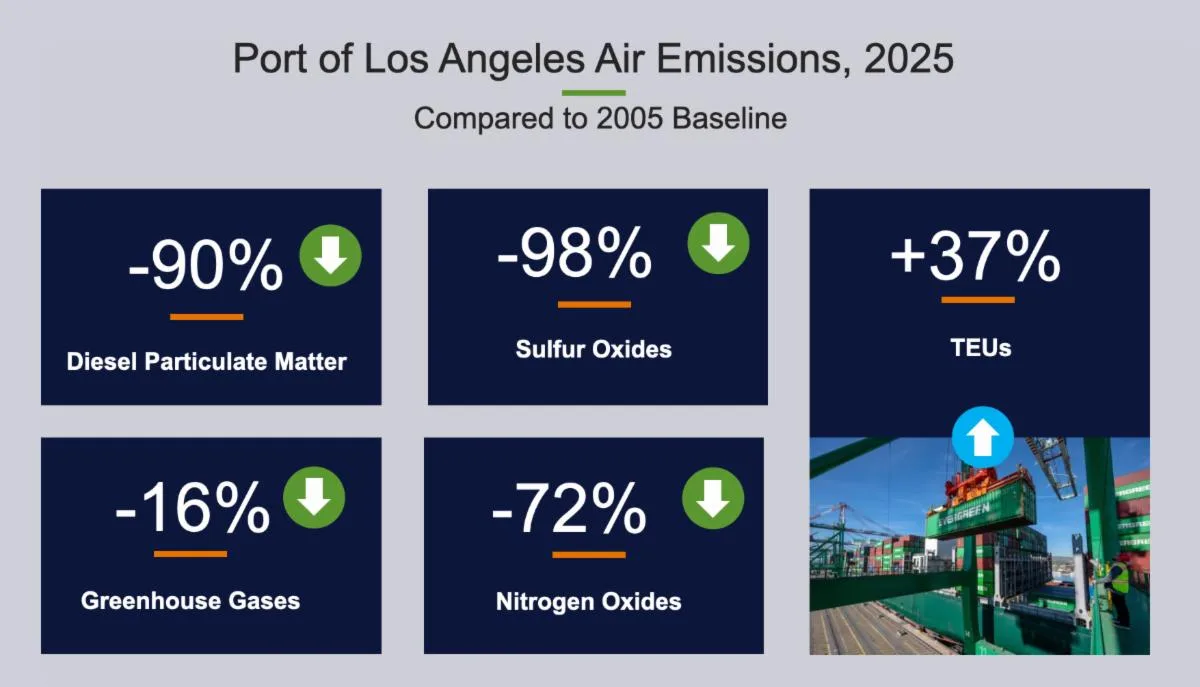
The Port of Los Angeles recorded its lowest emissions per container on record in 2025, according to its newly released Inventory of Air Emissions, marking further progress in efforts to reduce the environmental impact of port operations.
The latest findings show that emissions declined across all four major pollutant categories compared with 2024, while the port handled nearly 10.2 million twenty-foot equivalent units (TEU) during the year.
Diesel particulate matter (DPM) emissions decreased by 2%, nitrogen oxides (NOx) by 4%, sulfur oxides (SOx) by 5% and greenhouse gas (GHG) emissions by 3% year-on-year. The reduction in NOx also brought annual emissions of that pollutant to their lowest level since the port began tracking emissions in 2005.
The results form part of the port’s long-term clean air programme, which includes measures targeting emissions from ocean-going vessels, trucks, locomotives, harbor craft and cargo-handling equipment.
Long-term reductions across port operations
Since 2005, the Port of Los Angeles has reduced DPM emissions by 90%, NOx by 72%, SOx by 98% and greenhouse gas emissions by 16%, according to the inventory.
Over the same period, container volumes have increased by 37%, illustrating the difference between the development of cargo activity and the port’s reported emissions trends.
The latest figures also show progress since 2017, when the ports of Los Angeles and Long Beach updated their Clean Air Action Plan to accelerate the transition towards zero-emission operations.
Compared with that baseline, DPM emissions have declined by 15%, NOx by 38%, SOx by 28% and greenhouse gas emissions by 9%.
Gene Seroka, Executive Director of the Port of Los Angeles, attributed the results to investments, technological developments and cooperation across the maritime industry.
The port’s annual emissions inventory measures pollution associated with ships, trucks, trains, harbor craft and terminal equipment, providing a basis for assessing the impact of its clean air initiatives.
Cleaner trucks and terminal equipment support progress
Road transport recorded some of the largest year-on-year improvements in 2025, as newer vehicles continued replacing older diesel-powered trucks operating at the port.
Truck-related DPM emissions declined by 16% and NOx emissions by 25% compared with 2024. Since 2005, emissions from trucks have fallen by 98% for DPM, 94% for NOx and 97% for SOx.
Cargo-handling equipment also continued its transition towards cleaner technologies. The number of electric cargo-handling units increased by 20% during 2025, while zero-emission equipment accounted for 14% of all cargo-handling equipment operating at the port.
The port reported that the number of cleaner hybrid equipment units has increased tenfold since 2017. Compared with 2005, cargo-handling equipment emissions have declined by 83% for DPM, 87% for NOx and 84% for SOx.
Harbor craft operations also recorded long-term improvements, supported by fleet renewal and the use of renewable diesel. In 2025, 55% of harbor craft operating at the port met Tier 3 or Tier 4 emissions standards, compared with 20% in 2017.
Vessel emissions decline as clean air initiatives continue
Ocean-going vessels remain a central component of the port’s emissions reduction programme, with cleaner marine fuels, shore power and emissions capture technologies contributing to long-term improvements.
Since 2005, vessel-related DPM emissions have fallen by 94%, NOx by 58% and SOx by 98%. The port also reported that ship arrivals were 34% lower than in 2005, a factor contributing to the emissions trend.
Rail operations recorded a 1% reduction in emissions during 2025 compared with the previous year, attributed to a slight decline in rail activity. Since 2005, locomotive-related DPM, NOx and SOx emissions have decreased by 45%, 52% and 99%, respectively.
The Port of Los Angeles continues to pursue clean air measures through infrastructure investment, operational improvements, incentives and partnerships. These include the development of green shipping corridors with major Asian ports and cooperation with the Port of Long Beach and the South Coast Air Quality Management District.
The latest inventory provides a further assessment of the port’s progress under its Clean Air Action Plan, while the transition towards zero-emission maritime and landside operations remains an ongoing objective.