CEVA Logistics and Zalando introduce AI-powered returns automation
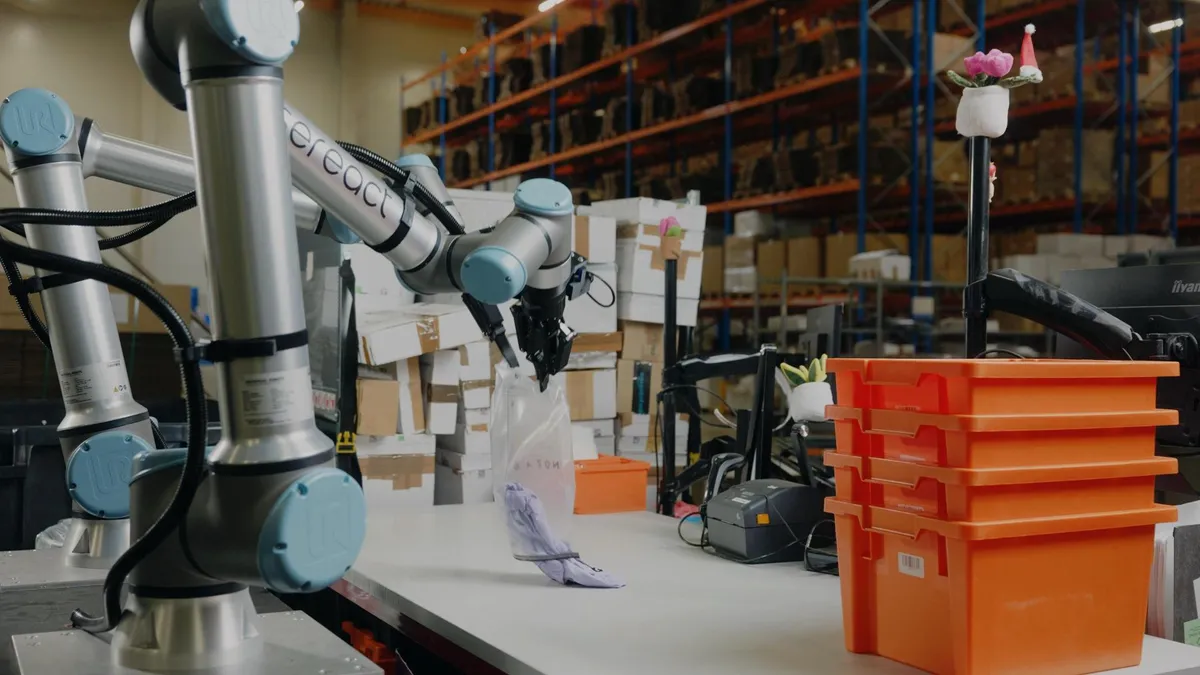
CEVA Logistics, Zalando and German robotics company Sereact have launched AI-powered automated returns processing at logistics facilities in Germany and Poland, introducing robotic systems designed to handle the operational challenges of fashion e-commerce returns.
The systems have entered live operations at facilities in Greven, Germany, and Świebodzin, Poland. They use dual-arm robots powered by Sereact’s Cortex artificial intelligence platform to identify, grasp and sort returned fashion items without requiring individual product training.
Announced on 7 October 2026, the deployment represents the first operational stage of a broader collaboration aimed at expanding automated returns handling across European logistics operations.
AI robots address complex returns operations
Returns processing presents particular challenges for fashion logistics operators because products arrive in varying conditions, packaging formats and configurations. Unlike standard warehouse picking operations, returned goods may require handling methods that cannot easily be predetermined.
Sereact’s Cortex platform is designed to recognise and manipulate previously unseen items, allowing robotic systems to respond dynamically to differences in product shape, positioning and condition.
According to the companies, the technology can identify, grasp and sort returned products without relying on fixed stock-keeping unit profiles or product-specific programming.
The systems have been deployed through a Robotics-as-a-Service (RaaS) model, under which robotic capabilities are provided as an operational service.
Chris Walton, Senior Vice President of Contract Logistics at CEVA Logistics, identified unpredictable volumes, manual quality checks, seasonal fluctuations and processing costs as major challenges in returns operations.
“Our Robotics-as-a-Service model classifies items faster, reduces manual touchpoints, and delivers consistent, predictable quality on a large scale,” said Walton.
Deployment forms part of wider European strategy
The launch follows Zalando’s participation in Sereact’s Series B funding round as a strategic investor in July 2026.
The investment forms part of the companies’ wider collaboration to develop and expand intelligent automation within their European logistics operations.
The partners intend to scale the technology beyond the initial deployments, although the announcement does not specify additional facilities, investment amounts or implementation dates.
The robotic systems are designed to take over repetitive physical handling tasks while warehouse employees continue to perform activities requiring human oversight.
According to the companies, this approach is intended to reduce physical strain and allow employees to focus on station supervision, exception management and quality control.
Masood Choudhry, Senior Vice President of Logistics at Zalando, said the collaboration brings together technological development and changes in warehouse operations.
Dr. Ralf Gulde, CEO and Co-Founder of Sereact, highlighted the technical challenges associated with processing fashion returns, particularly the need to handle items that robotic systems have not previously encountered.
“Returns are the hardest manipulation problem in fashion logistics,” said Gulde.
The installations in Greven and Świebodzin establish an initial operational application of the technology, with further expansion remaining part of the partners’ stated development plans.