Eastern Pacific Shipping secures financing for wind-assisted propulsion projects
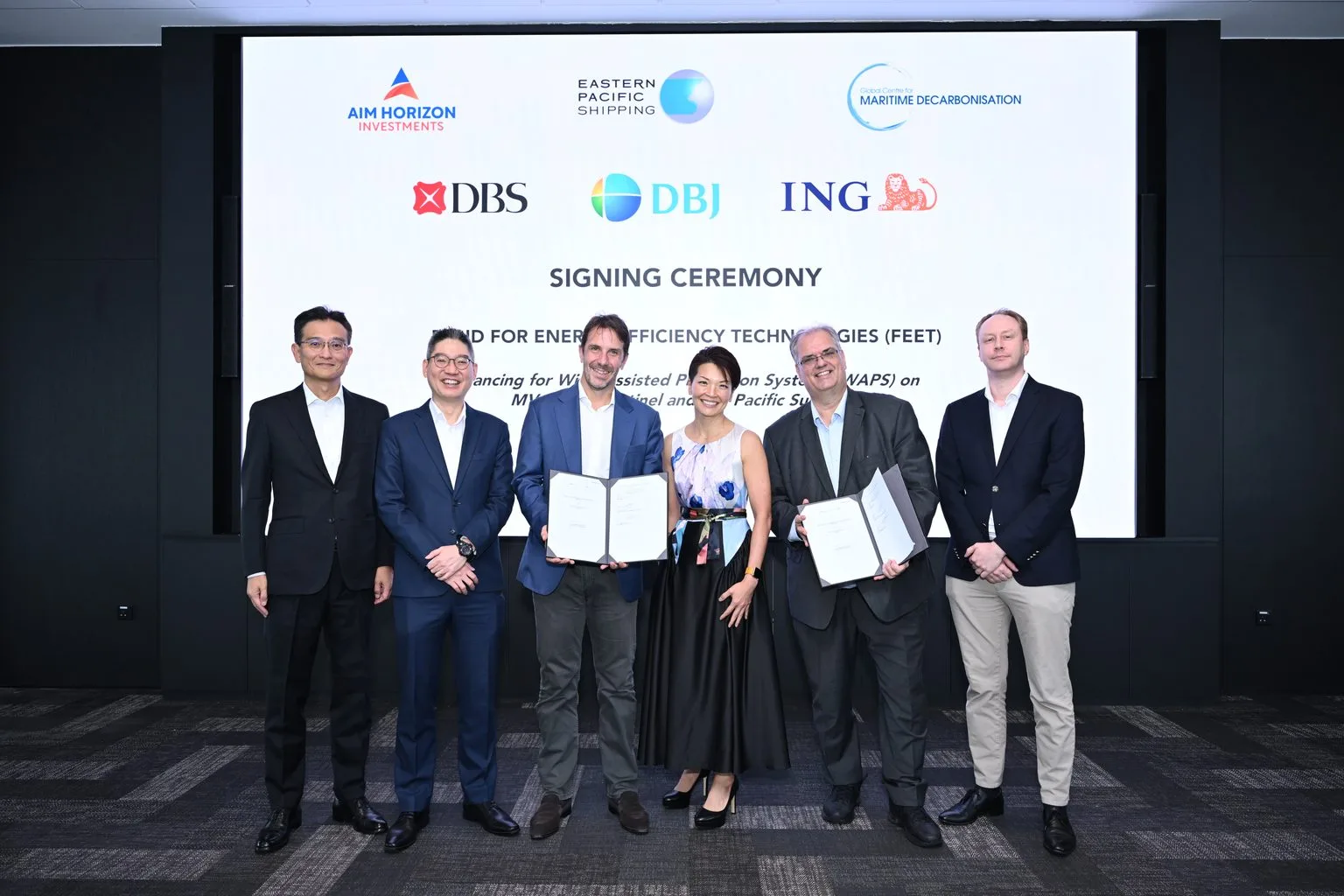
The Global Centre for Maritime Decarbonisation (GCMD), AIM Horizon Investments and Eastern Pacific Shipping (EPS) have announced the first deployment of financing through the Fund for Energy Efficiency Technologies (FEET), supporting wind-assisted propulsion systems installed on two EPS vessels.
The financing covers systems aboard MV Pacific Sentinel and MV Pacific Sunstone, the first two vessels in the EPS fleet to adopt wind-assisted propulsion technology.
Each vessel has been equipped with three 22-metre suction sails, designed to reduce fuel consumption by harnessing wind energy to supplement conventional propulsion.
The projects mark the initial deployment of FEET, a financing initiative designed to accelerate the adoption of energy efficiency technologies across the maritime industry.
Financing linked to verified fuel savings
FEET uses a pay-as-you-save model that connects financing repayments to independently verified fuel and regulatory savings generated by energy efficiency technologies installed on vessels.
The fund offers up to 100% upfront financing through a blended finance structure, aiming to reduce the initial investment burden for shipowners.
AIM Horizon Investments manages the fund, while GCMD serves as its decarbonisation advisor. The initiative is also supported by the Development Bank of Japan, DBS Bank and ING.
Under the financing model, operational data will be assessed to calculate fuel savings attributable to the installed technologies. These savings will be independently verified and used to determine payments from shipowners.
Operational data supports new financing approach
The first FEET deployment builds on earlier cooperation between GCMD and EPS to develop a methodology for measuring the fuel savings achieved by wind-assisted propulsion.
The assessment focused on MV Pacific Sentinel, with GCMD collecting approximately 276 million data points during four months of spot-market operations in the Americas between mid-May and mid-September 2025.
Researchers screened 203 valid transitions between operating conditions with the wind-assisted system switched on and off to assess its performance while accounting for variations in vessel operations.
The resulting methodology, reviewed by an independent third party, will now be applied to FEET-financed projects.
Project data will be audited, and calculated fuel savings will undergo independent verification before being used to determine financing payments.
Supporting wider adoption of maritime technologies
GCMD Chief Executive Officer Professor Lynn Loo said the initiative aims to connect operational evidence with financing arrangements that can encourage wider adoption of energy efficiency technologies.
Marcel de Bruijckere, Chief Executive Officer of AIM Horizon Investments, described the first deployment as an important demonstration of the fund’s financing concept.
EPS Chief Executive Officer Cyril Ducau highlighted the importance of combining technology, operational data and financing to support maritime decarbonisation.
The partners intend to use the experience gained from the initial projects to support further investments in vessel energy efficiency technologies.
The announcement does not disclose the financing amount for the two projects or specify the percentage of fuel savings achieved by the installed systems.