Bureau Veritas approves WinGD’s variable compression technology for marine engines
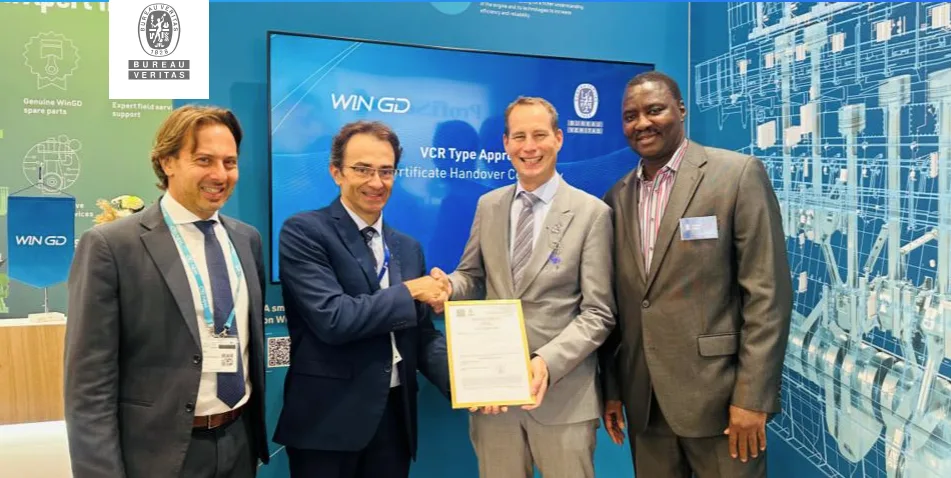
Bureau Veritas Marine & Offshore has granted Type Approval to WinGD’s Variable Compression Ratio (VCR) technology, marking an important development in the design and operation of marine dual-fuel engines.
The technology allows engine compression ratios to be adjusted according to fuel selection and operating conditions, rather than remaining fixed throughout the engine’s operating life.
According to Bureau Veritas, the system is designed to improve combustion efficiency, reduce fuel consumption and support lower emissions, while providing greater operational flexibility for vessels using different marine fuels.
The approval represents a step towards the wider application of variable compression technology in commercial shipping, although the announcement does not identify specific vessel installations or commercial deployment schedules.
Variable compression technology improves engine flexibility
Conventional marine engines operate with a fixed compression ratio determined during the design process.
This ratio describes the relationship between the volume inside the engine cylinder when the piston is at its lowest and highest positions.
WinGD’s VCR technology changes this approach by allowing the compression ratio to be adjusted dynamically during operation.
The system achieves this by altering the piston position, changing the combustion chamber volume and enabling the engine to operate with compression settings suited to different fuels and engine loads.
This flexibility is particularly relevant for dual-fuel engines, where combustion characteristics vary depending on the fuel being used.
By adapting compression settings to operating requirements, the technology is intended to reduce the efficiency compromises associated with conventional fixed-compression designs.
WinGD also identifies potential benefits during part-load operation, when vessels operate below maximum engine output to manage fuel consumption, speed and emissions.
Technology designed for newbuildings and future retrofits
According to the announcement, the VCR system uses a mechanical configuration that does not change the engine’s external footprint or installation requirements.
This design characteristic could support integration into newbuilding projects and potential future retrofit applications.
The technology is intended to provide shipowners with additional flexibility as they evaluate alternative fuels and seek to improve the efficiency of existing propulsion systems.
Dominik Schneiter, Chief Executive Officer of WinGD, said the system enables the company’s X-DF engines to adjust compression ratios according to engine load, supporting improved performance and fuel efficiency.
The company considers the Type Approval an important recognition of the technology’s design and technical capabilities.
Bureau Veritas recognises marine engine innovation
The approval follows the technical assessment of WinGD’s VCR technology by Bureau Veritas Marine & Offshore.
Christophe Chauviere, Marine & Offshore Technical & Operations Excellence Senior Vice-President at Bureau Veritas, highlighted the importance of technologies that improve engine efficiency while supporting the maritime industry’s transition towards lower-carbon operations.
The classification society said the ability to optimise engine performance across different fuels and operating conditions could contribute to more efficient vessel operations.
However, the announcement does not provide quantified fuel savings, independently verified emissions reductions or details of confirmed commercial installations.
The Type Approval therefore represents a technical approval milestone rather than evidence of fleet-wide deployment.
As shipowners continue to evaluate dual-fuel propulsion systems and alternative marine fuels, technologies capable of adapting engine performance to changing operating conditions are expected to remain an important area of marine engineering development.