Kawasaki delivers LPG-fuelled ammonia-capable carrier to Kumiai Navigation
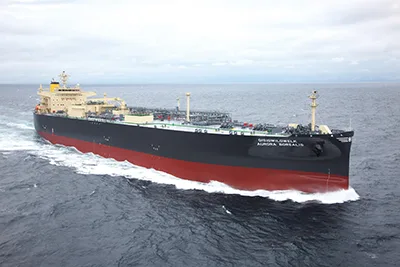
Kawasaki Heavy Industries has delivered the AURORA BOREALIS, an LPG-fuelled liquefied petroleum gas and ammonia carrier built for Kumiai Navigation (Pte) Ltd. The vessel was handed over on 29 October 2026 and is registered in Singapore.
The new carrier belongs to Kawasaki’s 86,700 m³ LPG/NH3 vessel series and is the fourteenth ship completed under this design. According to the shipbuilder, the delivery also brings its total number of LPG-fuelled vessels completed to 21, while the number of LPG carriers delivered throughout its history has reached 84.
The AURORA BOREALIS has a cargo tank capacity of 87,058 m³ and a deadweight of 56,375 tonnes. Measuring 229.90 metres in length and 37.20 metres in breadth, the vessel has been designed to provide increased cargo capacity while maintaining dimensions comparable to earlier LPG carriers, allowing it to use major LPG terminals worldwide.
A key feature of the vessel is its ability to carry LPG and ammonia simultaneously in separate cargo tanks. This arrangement provides flexibility for transporting the two products without requiring the ship to operate on ammonia fuel.
LPG propulsion and future fuel capability
The carrier is powered by a Kawasaki-MAN B&W 6G60ME-C10.5-LGIP electronically controlled marine engine, which can use LPG as fuel. Kawasaki states that operating on LPG can reduce sulphur oxide and carbon dioxide emissions compared with conventional marine fuel oil.
The propulsion system incorporates exhaust gas recirculation and selective catalytic reduction equipment to meet IMO Tier III nitrogen oxide requirements. Additional energy-saving features include Kawasaki’s rudder bulb and semi-duct systems, together with fins installed around the propeller to improve propulsion efficiency.
The vessel is also fitted with a shaft generator connected to the main engine’s propeller shaft. During normal navigation, this arrangement allows electricity to be generated using the main engine, reducing the need to operate separate diesel generators. Kawasaki says the vessel can consequently operate predominantly on LPG fuel, apart from a small quantity of pilot fuel.
Although the AURORA BOREALIS currently uses LPG for propulsion, its design includes provisions for a possible future conversion to ammonia fuel. The concept design for such a system has received approval from classification society Nippon Kaiji Kyokai (ClassNK).
The vessel has a reported service speed of approximately 17 knots and a crew complement of 29. Its delivery forms part of Kawasaki’s continuing construction programme for gas carriers designed to transport LPG and ammonia while incorporating alternative-fuel propulsion technologies.