Busan New Port deploys AI collision prevention system
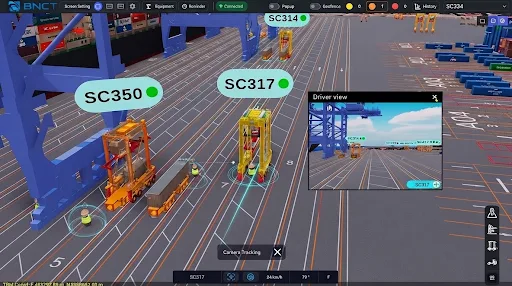
CyberLogitec has deployed an artificial intelligence-based collision prevention system at Busan New Container Terminal (BNCT) in South Korea, introducing real-time monitoring technology designed to reduce the risk of accidents involving terminal workers and cargo-handling equipment.
The system, installed at Terminal 5 of Busan New Port, detects workers without requiring them to wear electronic tags or tracking devices. It combines AI-powered cameras, precise equipment positioning and digital twin technology to identify potentially dangerous proximity between personnel and straddle carriers.
According to CyberLogitec, the platform alerts equipment operators when a worker enters predefined distance thresholds within the same operational lane, allowing drivers to respond to potential collision risks.
Digital twin connects workers and terminal equipment
The system is built around CyberLogitec’s digital twin-based port monitoring platform, which displays the positions of workers and mobile equipment within a shared coordinate system.
AI cameras installed on ship-to-shore (STS) cranes detect workers, while a vision-to-geolocation method developed jointly by CyberLogitec and GlobeAI converts those detections into real-world coordinates.
The information is combined with real-time kinematic (RTK) positioning data from straddle carriers, allowing the platform to calculate distances between workers and moving equipment.
CyberLogitec said the system determines workers’ locations without identifying individual people.
To reduce unnecessary warnings, the technology evaluates proximity only when a worker and a straddle carrier occupy the same working lane. Alerts are activated at distances of 15, 10 and 5 metres and displayed as directional indicators inside the vehicle cabin.
“Under an STS crane, a colleague working safely in the next lane is often only a few metres away,” said Dr Junhee Cho, Digital Team Leader at CyberLogitec, who led the development.
Cho explained that limiting unnecessary alarms was an important consideration in maintaining driver confidence in the system.
Deployment includes cameras and precision positioning
The installation at BNCT includes 28 AI cameras mounted on 14 STS cranes, while RTK receivers have been fitted to approximately 70 mobile equipment units.
Worker detection is supported by GlobeAI’s deep-learning vision technology, developed to operate under challenging terminal conditions, including poor lighting, fog and rain.
Equipment positioning uses LG Uplus’s RTK network, which draws on more than 200 reference stations across South Korea to address positioning challenges associated with container stacks and other port infrastructure.
According to CyberLogitec, field validation recorded equipment positioning accuracy of better than 3 centimetres and worker localisation accuracy of better than 20 centimetres.
The platform also includes a 3D Virtual Terminal interface in the control room, enabling operators to monitor activity, review historical events and investigate near-miss incidents.
Alert records can be retained for subsequent analysis, while integration with the OPUS Terminal operating system connects the safety platform with existing terminal operations.
Further deployment planned
CyberLogitec developed the system amid growing industry attention to vehicle–pedestrian safety in cargo-handling environments.
The company referenced industry safety concerns raised by ICHCA International, as well as an August 2026 initiative involving PEMA, TT Club and ICHCA International calling for stronger collision prevention measures at terminals.
“Safety is never open to compromise and remains our highest priority,” said Chris Choi, CEO and Representative Director of BNCT.
Choi said the collaboration with CyberLogitec had strengthened the terminal’s preventive approach to managing operational safety risks.
The system can also be extended to terminal tractors and other types of mobile handling equipment.
CyberLogitec plans to introduce the technology at additional ports in South Korea and overseas, although no specific locations or deployment dates have been announced.