European port cooperation: 7 ports back new cross-border agreement
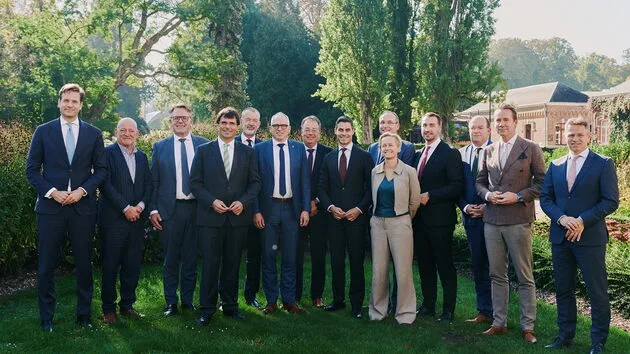
European port cooperation is set to strengthen following an agreement between Flanders, the Netherlands and Germany’s North Rhine-Westphalia on energy infrastructure, inland navigation and logistics development.
The agreement was reached during a Port Summit held in Meise, Belgium, on 5 October, bringing together government representatives and executives from seven major ports in the Antwerp-Rotterdam-Rhine-Ruhr Area (ARRRA).
The three governments adopted a joint declaration outlining priorities for improving the competitiveness of the region’s interconnected ports and industrial facilities.
The ARRRA cluster generates approximately €65 billion in added value and supports nearly 600,000 jobs. However, high energy prices, international competition, lengthy permitting procedures and regulatory fragmentation are placing increasing pressure on businesses operating across the region.
The agreement seeks to address these challenges through closer coordination between governments, ports and industrial stakeholders.
European port cooperation focuses on energy and transport
A central priority of the agreement is accelerating cross-border energy infrastructure, particularly for hydrogen and carbon dioxide transport and storage.
The governments intend to coordinate the development of pipelines, improve investment certainty and address regulatory differences that can delay major infrastructure projects.
Another objective is the development of a cross-border market for secondary raw materials. The initiative focuses on strengthening circular industrial supply chains and creating more consistent conditions for businesses involved in material recovery and reuse.
Inland navigation also features prominently in the declaration. The three regions plan to strengthen cooperation on strategic water management and the sustainability of inland shipping.
Climate change has increased concerns about the resilience of inland waterways, making coordinated water management an important part of the regional transport agenda.
The governments also identified opportunities to expand automated freight transport across national borders.
Cross-border corridors, including the Antwerp–Rotterdam route, could be used to introduce automated transport systems on roads and waterways. Cooperation on drone operations is also being considered, provided that regulatory frameworks and operating procedures can be better aligned.
Seven ports support closer regional coordination
The initiative involves Duisport, North Sea Port, Port of Antwerp-Bruges, Port of Cologne/HGK, Port of Moerdijk, Port of Oostende and Port of Rotterdam.
These ports form part of an interconnected industrial and logistics network serving businesses across Belgium, the Netherlands and Germany.
The participating ports welcomed the outcome of the summit, having previously called for greater regulatory consistency and improved conditions for cross-border investment.
Earlier this summer, they issued a joint letter requesting a more level playing field for businesses operating within the region.
The letter also highlighted the need for stronger cross-border energy infrastructure and faster permitting procedures through designated acceleration areas.
The latest agreement builds on existing cooperation between the ports, while establishing common priorities for future coordination between the three governments.
Governments call for European Union support
European port cooperation is also at the centre of a joint appeal to the European Commission.
Flanders, the Netherlands and North Rhine-Westphalia have asked the Commission to recognise ARRRA as a strategic European port-industrial cluster.
The three governments are seeking faster progress on cross-border energy infrastructure, greater regulatory clarity and improved funding opportunities for major port transition projects.
They consider these measures important for maintaining industrial competitiveness and supporting Europe’s energy supply and strategic autonomy.
Marcus Optendrenk, a minister from North Rhine-Westphalia, stressed the importance of coordinating regulations across national borders.
“Our ports, waterways and logistics routes do not stop at national borders. Automated transport on roads, waterways and in the air will only become a competitive advantage if we set the rules together,” said Optendrenk.
The joint declaration sets out shared policy priorities, although the announcement does not specify individual project budgets or implementation deadlines.
The next stage of cooperation will depend on how the three governments translate these commitments into coordinated infrastructure development, regulatory measures and investment initiatives.