Samsung Heavy Industries and partners to develop nuclear-powered LNG carrier
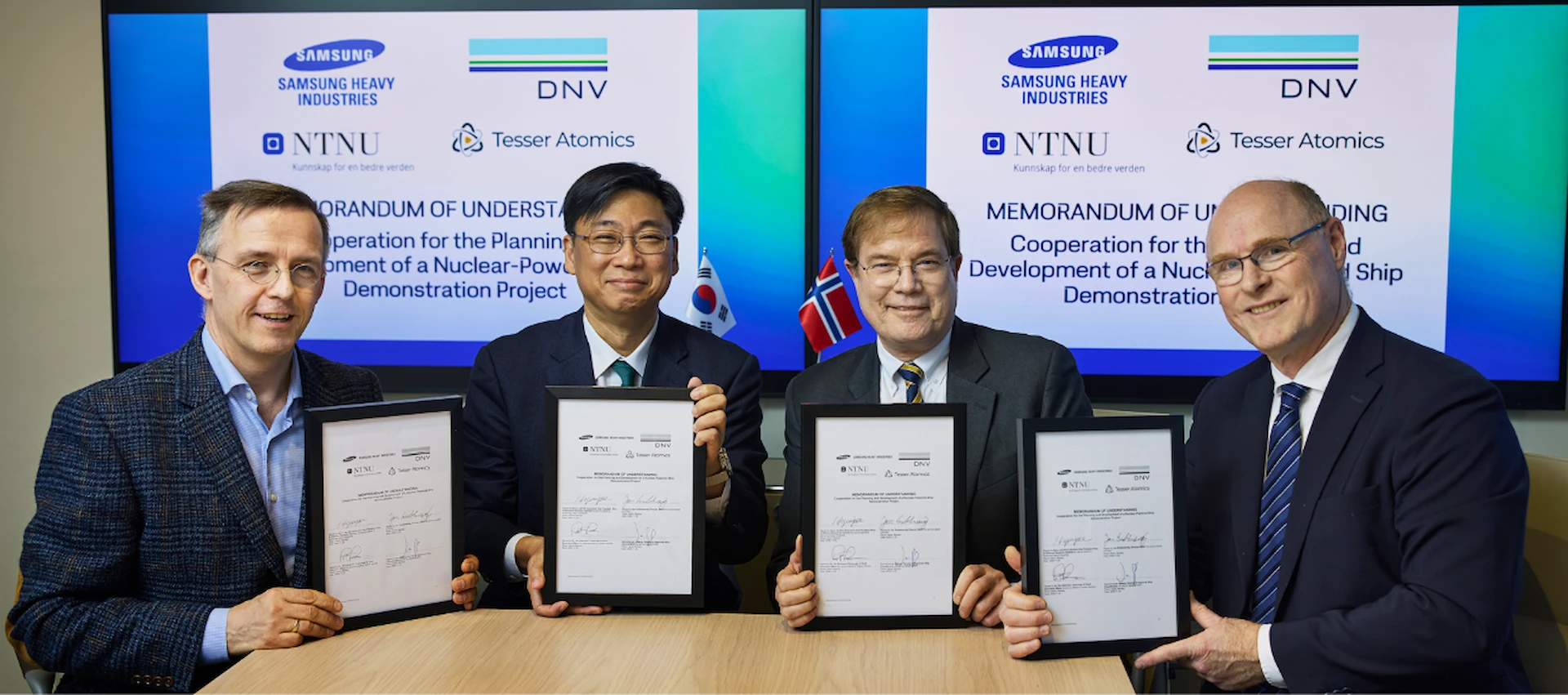
Samsung Heavy Industries (SHI), Tesser Atomics, the Norwegian University of Science and Technology (NTNU) and classification society DNV have signed a Memorandum of Understanding (MOU) to develop a nuclear-powered liquefied natural gas (LNG) carrier demonstration project.
The agreement, announced on 23 November 2026, brings together expertise in shipbuilding, nuclear reactor technology, maritime safety and academic research. The proposed vessel concept is intended for operation between LNG terminals in the United States and Europe.
The partners will initially develop a technical roadmap covering the vessel concept, safety assessment and approval requirements, with the longer-term objective of establishing a practical pathway towards construction and commissioning.
Nuclear reactor technology at the centre of vessel concept
The proposed LNG carrier will be designed around Tesser Atomics’ marinized fluoride-salt-cooled reactor technology.
Samsung Heavy Industries will lead development of the vessel concept, including the integration of the nuclear power system into the ship’s design and the evaluation of shipbuilding feasibility and construction methods.
Tesser Atomics will take responsibility for reactor technology development, the nuclear power plant and reactor-specific safety and licensing activities.
The project will also serve as a reference for SFI SAINT, Norway’s research centre dedicated to nuclear-powered vessels, coordinated through NTNU.
“Nuclear-powered vessels are one of the promising eco-friendly alternatives for transportation amid the global trend toward decarbonization,” said Kyunghee Kim, Executive Vice President and Head of the Future Business Division at Samsung Heavy Industries.
Kim said the project would build on the shipbuilder’s experience in marine small modular reactors and contribute to efforts towards the commercialisation of nuclear-powered vessels.
DNV to support safety assessment and classification
DNV will contribute maritime safety, classification and risk assessment expertise to the project.
Its responsibilities will include hazard identification, development of a safety assessment framework and preparation of a roadmap for classification and verification.
These activities will support the partners as they examine the technical and regulatory requirements involved in developing a commercial nuclear-powered cargo vessel.
“One of the interesting things about nuclear power for shipping is that we have a long track record of use in the naval segment, but that this has not translated into the commercial sector,” said Ivar Håberg, Director of Approval Ship Classification at DNV.
Håberg described the collaboration as an important step towards developing a modern full-scale nuclear-powered cargo vessel.
NTNU will coordinate research activities, funding proposals and development of the project consortium. The university will also contribute to feasibility studies, modelling, simulations and testing.
Project targets transatlantic LNG transportation
The proposed demonstration vessel is being developed around an operating concept connecting LNG terminals in the United States and Europe.
The partners intend to examine whether the nuclear power system can be integrated into a commercially viable LNG carrier while meeting the necessary safety, regulatory and operational requirements.
According to DNV, the work could eventually provide a technical foundation for applying similar nuclear propulsion concepts to other merchant vessel categories, including container ships.
However, the project remains at the concept development stage. The partners have not announced a shipbuilding contract, vessel specifications, construction schedule or expected commissioning date.
No investment value or final regulatory approval has been disclosed.
The agreement represents an early development step towards evaluating nuclear propulsion for commercial LNG transportation, with further technical studies and safety assessments required before any demonstration vessel can proceed towards construction.