Crude tanker rates retreat as VLCC earnings remain exceptionally high
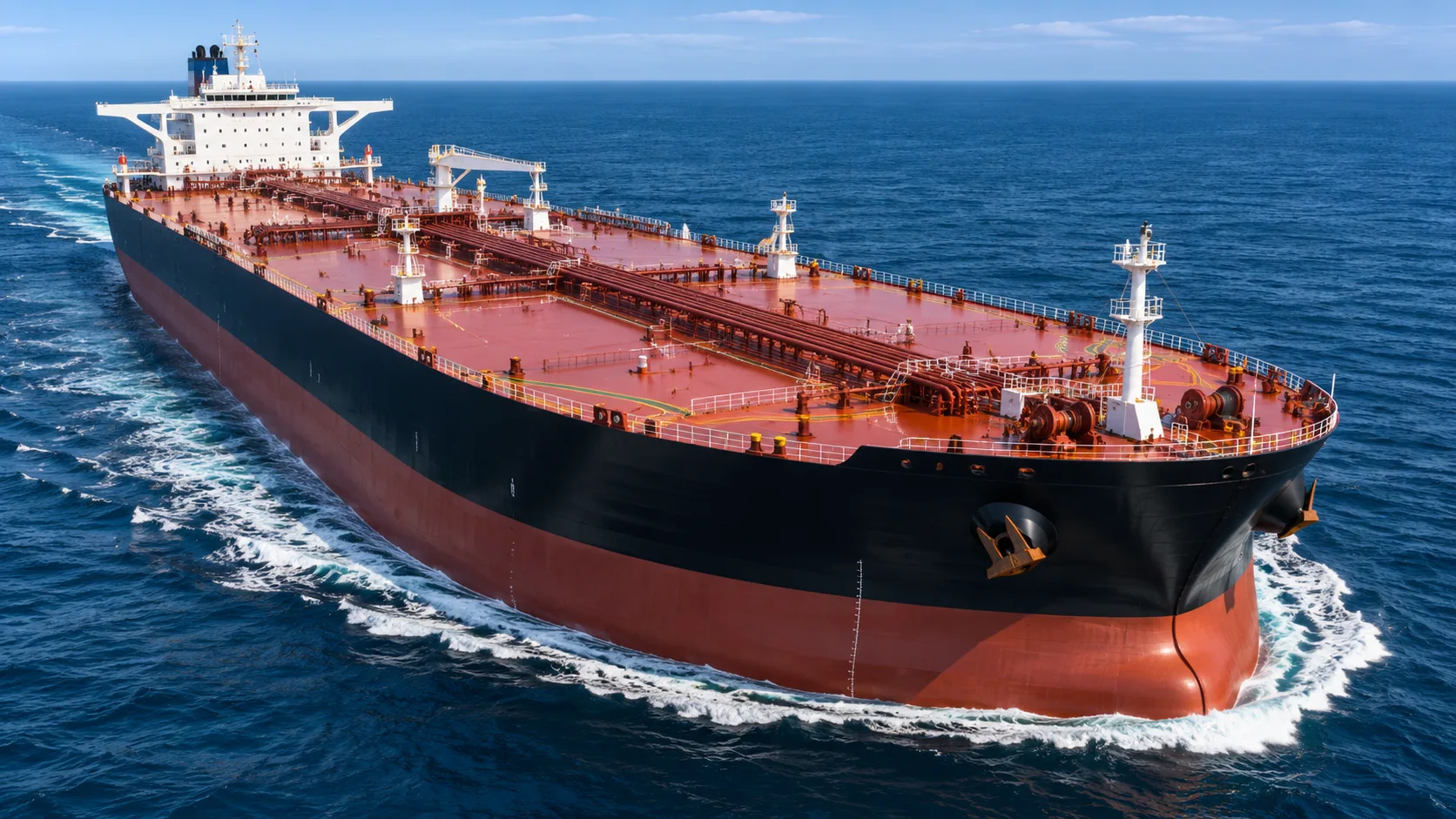
Crude oil tanker freight rates continued to decline during the week ending 13 November 2026, with substantial corrections across VLCC, Suezmax and Aframax routes, although calculated daily earnings remained exceptionally elevated in several major trading corridors.
According to the Baltic Exchange’s latest weekly market report, the Middle East Gulf–China VLCC route (TD3C) fell by 188 Worldscale points to WS1014.38. The assessment translated into a round-trip time charter equivalent (TCE) of $1,078,714 per day for the standard Baltic VLCC, down from approximately $1.30 million a week earlier.
The decline illustrates the continuing adjustment in crude tanker markets following a period of exceptionally strong freight rates. Despite the correction, benchmark earnings on several international crude oil routes remained at levels substantially above those typically associated with more balanced market conditions.
VLCC rates decline across major routes
The downward movement extended beyond the Middle East Gulf–China trade, with other VLCC benchmarks recording significant weekly reductions.
On the Gulf of Oman–China route (TD34), the Baltic Exchange assessment declined by 234 Worldscale points to WS310.71, equivalent to a round-trip TCE of $307,160 per day.
Atlantic markets also weakened. The West Africa–China route (TD15) declined by 210 Worldscale points to WS288.57, corresponding to calculated daily earnings of $267,748.
Meanwhile, the US Gulf–China route (TD22) recorded a reduction of more than $19.6 million in its lump-sum freight assessment, which fell to approximately $33.8 million. The corresponding Baltic round-trip TCE was estimated at $247,973 per day.
The figures indicate that the weekly correction affected both Middle Eastern and Atlantic loading regions, although earnings levels and the magnitude of the decline varied considerably between individual routes.
Suezmax and Aframax markets face further pressure
The Suezmax segment followed the same downward direction, with freight rates declining across all routes covered in the Baltic Exchange report.
The Nigeria–UK Continent route (TD20) fell by 92 Worldscale points to WS307.22, producing a calculated round-trip TCE of approximately $151,300 per day. On the Guyana–UK Continent route (TD27), the assessment declined by 47 points to WS313.33, equivalent to just under $157,600 per day.
The US Gulf–UK Continent Suezmax route (TD33) also weakened, closing at WS267.22, while the Black Sea CPC–Augusta route (TD6) recorded a particularly sharp decline of 192 Worldscale points to just below WS425. Despite that reduction, its corresponding daily TCE remained close to $305,000.
Aframax rates also declined across the principal markets. In the North Sea, the Cross-UK Continent route (TD7) fell to WS247.5, producing calculated daily earnings of just under $141,300.
In the Mediterranean, the Ceyhan–Lavera route (TD19) declined to WS267.78, equivalent to approximately $86,000 per day. Atlantic Aframax benchmarks also weakened, with East Coast Mexico–US Gulf, Covenas–US Gulf and US Gulf–UK Continent routes all registering lower freight assessments.
The Vancouver–China crude oil route (TD28) declined by $1.115 million to $8.565 million on a lump-sum basis, corresponding to a round-trip TCE below $171,300 per day.
Product tanker markets show mixed performance
Product tanker freight markets presented a more varied picture, with some Middle East routes maintaining upward momentum while others weakened.
In the LR2 segment, the Middle East Gulf–Japan route (TC1) increased by eight Worldscale points to WS1016, corresponding to a Baltic round-trip TCE of approximately $298,000 per day.
The Middle East Gulf–UK Continent LR2 route (TC20) also strengthened, with its lump-sum assessment rising by $264,000 to $19.23 million. The corresponding calculated daily earnings reached $297,300.
By contrast, the Mediterranean–East LR2 route (TC15) declined, while the LR1 Middle East Gulf–Japan route (TC5) weakened by 13 Worldscale points to WS1005.
In the MR market, the Middle East Gulf–East Africa route (TC17) strengthened by 27 points to WS924, with calculated earnings reaching $119,500 per day. However, US Gulf routes remained under pressure, and the MR Atlantic Triangulation Basket TCE declined from $72,700 to $67,100 per day.
The Baltic Exchange figures therefore point to a tanker market undergoing a broad correction in crude oil transportation rates, alongside more uneven conditions in refined product shipping.
Although headline VLCC earnings remain unusually high, the latest weekly declines underline the volatility of freight markets and the considerable differences between regional trading routes.
The assessments represent Baltic Exchange benchmark calculations rather than realised earnings for individual vessels, which depend on charter terms, vessel specifications, operating costs and actual employment.