Panama Canal reviews strategic projects and global trade challenges
The Panama Canal’s Board of Directors and Advisory Board convened their 41st meeting to review developments in global maritime trade, assess the waterway’s strategic priorities and discuss initiatives aimed at maintaining its long-term competitiveness.
The meeting brought together senior Canal officials and international maritime and logistics experts to examine operational challenges, infrastructure development and future revenue opportunities. Discussions included the Canal’s water management strategy in response to the El Niño phenomenon, revenue diversification and its position within global shipping networks.
The programme also included presentations on two complementary infrastructure initiatives, a proposed gas pipeline and an extension of the logistics corridor. Canal officials outlined progress on these projects during visits to operational facilities and areas associated with their planned development.
Infrastructure projects and operational priorities
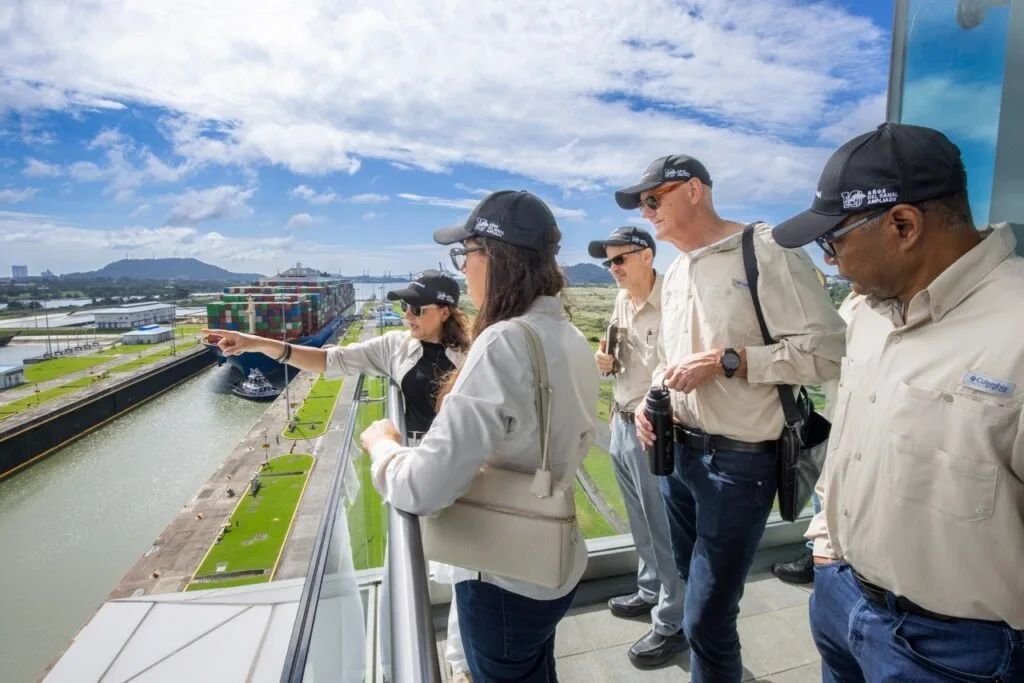
Members of both boards visited the Cocolí Locks and the Integrated Operations Control Center (CICO), where vessel movements through the waterway are coordinated. The visit also covered part of the area identified for the development of the gas pipeline and logistics corridor extension.
Panama Canal Administrator Ilya Espino de Marotta and Deputy Administrator Miguel Lorenzo presented updates on these initiatives, alongside information about lock operations and the Canal’s traffic management systems.
Water management remains among the issues under consideration, particularly in relation to the El Niño phenomenon and its implications for the Canal’s operations. The boards are also examining opportunities to diversify revenue and maintain the waterway’s competitiveness amid changes in global maritime trade.
“The Advisory Board’s recommendations are a valuable input into the decisions we make regarding the Canal’s future,” said José Ramón Icaza, Minister for Canal Affairs and Chairman of the Board of Directors.
Icaza said the board’s international perspective supports the Canal’s efforts to anticipate changes in global trade and maintain reliable and sustainable operations.
Advisory Board leadership changes
The meeting also marked a transition in the leadership of the Panama Canal Advisory Board, with Danish maritime executive Tommy Thomsen succeeding Admiral William J. Flanagan as chairman.
Thomsen has more than three decades of experience in the maritime and shipping industry and currently leads Lauritzen Fonden, a Danish corporate foundation.
“The Panama Canal faces an environment of profound change, yet it is uniquely positioned to remain a key connector of global trade,” Thomsen said.
Two new members have also joined the Advisory Board: Oscar Hasbún Martínez, Chief Executive Officer of Compañía Sud Americana de Vapores (CSAV), and Jean Paul Rodrigue, Professor of Maritime Business Administration at Texas A&M University at Galveston.
Hasbún brings experience in shipping and logistics through his leadership of CSAV, the largest shareholder in Hapag-Lloyd, and his role as Chairman of SM SAAM. Rodrigue contributes academic expertise in maritime transport, logistics and global trade networks.
Established in December 1999 under the Panama Canal Organic Law, the Advisory Board provides strategic recommendations to the Canal’s Board of Directors and Administration. Its members represent sectors including transportation, international trade, finance, infrastructure and academia.
The 41st meeting provides a forum for reviewing the Canal’s ongoing initiatives and operational priorities. The announcement did not identify new investment approvals or final decisions concerning the proposed gas pipeline and logistics corridor extension.