Maersk, Hapag-Lloyd and ONE: Is the return to Suez reshaping container shipping?
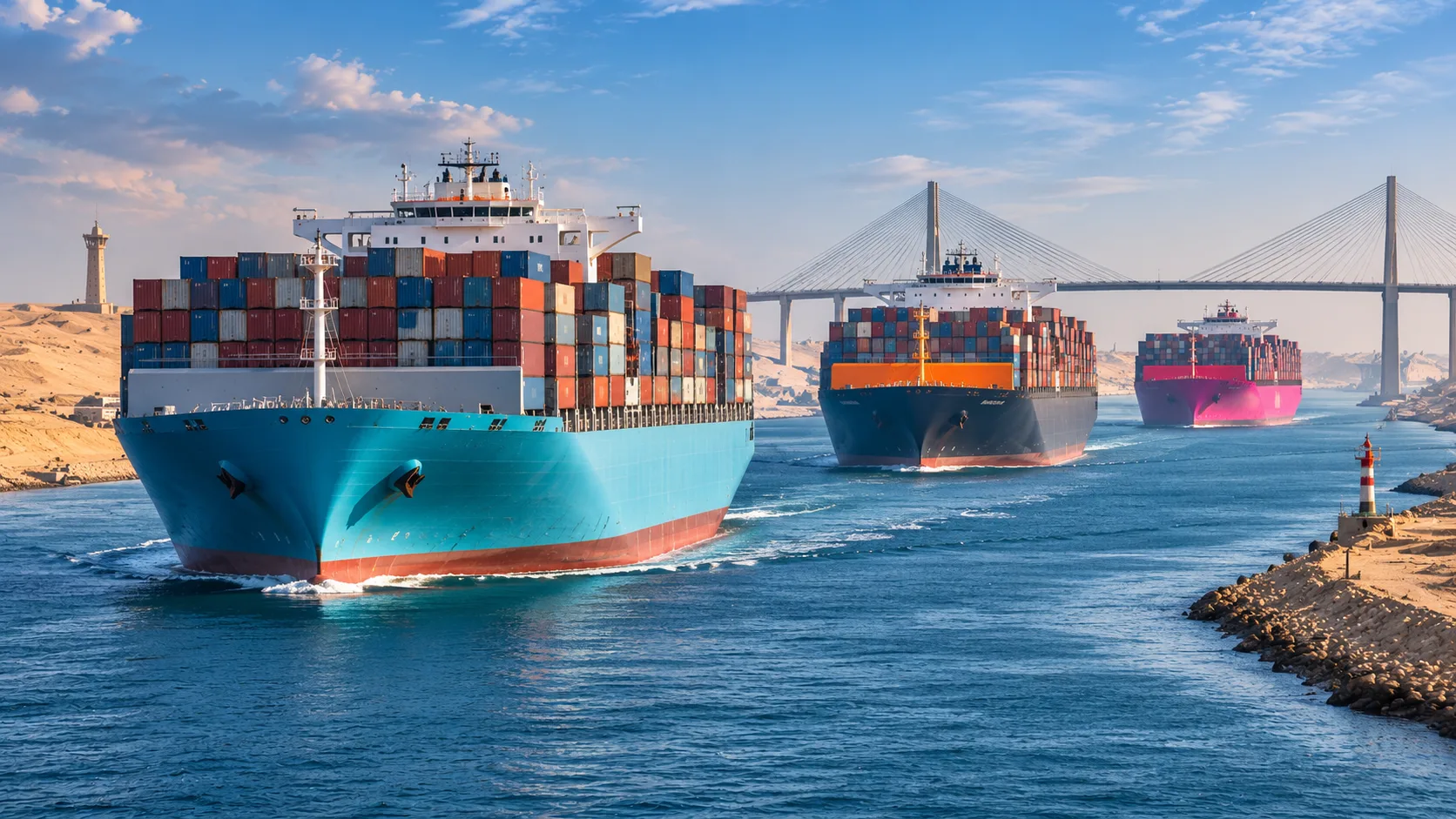
The gradual return of major container shipping lines to the Suez Canal is moving beyond isolated vessel passages and into a potentially more consequential phase: the restructuring of established East–West shipping networks.
Within days, Maersk and Hapag-Lloyd have announced plans to move three additional Gemini Cooperation services back through the Red Sea, while Ocean Network Express (ONE) has completed a Suez Canal transit under the Premier Alliance network. The developments involve some of the world’s most recognisable container carriers and raise a question extending well beyond the Egyptian waterway: how could shorter voyages change the competitive balance between shipping alliances?
The answer will depend not only on how quickly services return, but also on how carriers manage vessel capacity, schedule reliability and the commercial consequences of reversing the longer routes around the Cape of Good Hope.
Gemini’s Suez strategy is becoming more substantial
On 16 November 2026, Maersk announced that the Gemini Cooperation, operated with Hapag-Lloyd, would structurally reroute its AE1, AE2 and AE3 services through the Suez Canal rather than around southern Africa.
The changes are scheduled to begin with the AE2 service, involving Mary Maersk from Ningbo on 4 December, followed by AE3 with Alette Maersk from Shanghai on 20 December. AE1 is scheduled to follow with Damietta Express departing from Shanghai in January 2027. These are the starting dates for the affected service changes, not confirmed dates of passage through the canal.
The announcement represents a further expansion of a transition already underway. Earlier in 2026, Gemini had announced trans-Suez changes involving several Asia–Europe and India–Europe services, followed by the November restructuring of the ME1 service connecting India and Europe.
As pelavox. reported on 17 November, the latest decision extends the carriers’ planned return across additional major East–West routes. Maersk’s official service advisory confirms the affected rotations and their implementation schedules.
The strategic significance lies in the nature of the changes. Rather than arranging individual transits whenever circumstances permit, Gemini is progressively incorporating the Suez Canal into its network design.
That distinction matters because structural service changes influence port rotations, vessel deployment, connection opportunities and the operating assumptions underpinning a carrier’s schedule.
For a cooperation built around coordinated mainline services and connecting hubs, the transition is not simply a matter of choosing a shorter route. It also requires adjustments across the wider network.
ONE and Premier Alliance introduce another competitive dimension
The Gemini announcement follows a separate development involving Ocean Network Express.
On 15 November, the 8,110-TEU ONE CONTINUITY passed through the Suez Canal while travelling from Singapore towards the Netherlands. According to the Suez Canal Authority, the vessel operates on the FE1 service associated with Premier Alliance, whose members include ONE, HMM and Yang Ming.
The authority also stated that three additional Premier Alliance services were expected to return to the canal, although it did not identify their implementation dates in that announcement.
The development was covered by pelavox. in its report on ONE’s return to Suez.
The completed passage provides evidence of an actual operational return, while the prospect of additional services points towards a potentially broader network transition. Nevertheless, one completed voyage does not establish that the entire FE1 rotation has permanently shifted to Suez, or that all Premier Alliance services will follow the same approach.
That uncertainty is important when comparing Premier Alliance with Gemini.
Maersk and Hapag-Lloyd have published specific structural changes and implementation schedules for three additional services. The Suez Canal Authority, meanwhile, has confirmed ONE CONTINUITY’s transit and referred to further expected Premier Alliance returns without providing equivalent details for all those services.
Both developments matter, but they are not identical measures of progress.
The competitive implications extend beyond transit time
The principal operational attraction of the Suez Canal is straightforward: for many Asia–Europe services, the route is shorter than navigating around the Cape of Good Hope.
Shorter voyages can reduce sailing distances and fuel requirements while potentially improving cargo transit times. They can also alter the number of vessels needed to maintain a particular weekly service frequency.
The latter effect could become especially important for the container shipping market.
During the Red Sea disruption, longer diversions absorbed vessel capacity by increasing round-voyage durations. Ships that would otherwise have completed voyages more quickly remained committed to extended rotations, increasing the fleet resources required to maintain service coverage.
A sustained return to shorter routes could reverse part of that effect.
If carriers maintain similar service frequencies and commercial capacity commitments while shortening round voyages, some vessels may become available for redeployment elsewhere. This would effectively increase usable shipping capacity without requiring the delivery of additional ships.
However, the scale of any capacity release cannot be established from the latest announcements alone. It would depend on how many services complete the transition, their vessel sizes, revised schedules, port rotations and the extent to which carriers retain additional operational buffers.
The market implications are therefore potentially significant, but they should not be presented as an immediate or quantifiable increase in supply.
Could the return to Suez put pressure on freight rates?
A broader return to Suez could create downward pressure on freight rates if shorter rotations release enough vessel capacity to increase effective supply relative to cargo demand.
That mechanism is particularly relevant because container carriers are already managing fleet expansion, newbuilding deliveries and changing trade patterns. The interaction between additional physical capacity and the release of vessels previously tied up on longer routes could complicate attempts to maintain balanced supply.
Yet lower freight rates are not an automatic consequence of reopening shorter routes.
Carriers can adjust capacity through vessel redeployment, sailing frequency changes, service consolidation and other network decisions. Cargo demand, port congestion, operating costs and the pace of the security transition would also influence the eventual market outcome.
Moreover, the commercial effects may vary between carriers and trade lanes.
An operator that successfully reduces transit times and improves schedule reliability could strengthen its customer proposition even if the wider market experiences greater rate competition. Conversely, a carrier that struggles to coordinate its network transition could face temporary disruption despite the shorter sailing distance.
The central issue is therefore not simply whether Suez reduces operating costs, but how much of any operational benefit carriers retain and how much is ultimately passed through to customers.
Schedule reliability may become the decisive battleground
The Gemini Cooperation has placed network coordination and schedule reliability at the centre of its operating model. A structural return to Suez creates an opportunity to shorten certain routes, but it also introduces a new test of that model.
Switching established services requires coordination across port calls, vessel schedules, feeder connections and cargo bookings. Any inconsistency between planned and actual transit arrangements could affect the predictability that customers expect from the network.
For Premier Alliance, the challenge is similar, although its network structure and service arrangements differ.
A successful transition could improve transit-time competitiveness, particularly where shippers place significant value on shorter delivery windows. But those gains will matter commercially only if the revised services can operate consistently.
This creates an important distinction between the theoretical efficiency of a shorter route and the reliability of the service that actually uses it.
Carriers may be able to advertise faster transit times, but customers will ultimately judge performance through delivery predictability, schedule adherence and the stability of connections across the network.
As a result, the return to Suez could become a test of operational execution as much as network strategy.
Evergreen shows that the transition is wider than two alliances
The latest developments are not confined to Gemini and Premier Alliance.
On 8 November, Evergreen’s 16,556-TEU EVER EON passed through the Suez Canal, marking another notable return by a major container carrier. The vessel was operating on the NEU 7 service associated with Ocean Alliance.
As pelavox. reported, the passage was accompanied by expectations of further Evergreen-operated transits, although these remained subject to operational conditions.
The participation of vessels associated with different alliance networks suggests that the return to Suez is developing into a wider industry adjustment rather than a decision limited to one carrier or cooperation.
It does not, however, demonstrate that the three major alliance networks have completed equivalent structural transitions.
The distinction between individual transits, announced service changes and fully implemented network restructuring remains essential.
For the shipping market, the importance of these developments will increase as more carriers move from selective passages to repeatable, scheduled operations through the canal.
Security remains the principal constraint
Despite the commercial advantages of shorter voyages, the pace of the transition remains tied to security conditions in the Red Sea and surrounding region.
Maersk and Hapag-Lloyd have explicitly stated that further changes will depend on continued assessments of regional stability, with the safety of crews, vessels and cargo remaining their priority.
That position limits the extent to which the latest announcements can be interpreted as a definitive restoration of pre-crisis shipping patterns.
Carriers must balance the potential benefits of shorter routes against the possibility that renewed instability could require further diversions.
Such reversals would create costs of their own, particularly if services had already been redesigned around Suez and associated port and feeder connections had been adjusted.
The economic case for returning to the canal is therefore inseparable from the durability of the security environment.
A gradual, selective approach may allow carriers to test operational conditions while avoiding an immediate system-wide commitment. It also means that the industry’s transition could remain uneven, with different carriers and services progressing at different speeds.
Is the competitive balance beginning to shift?
The developments of mid-November 2026 indicate that the Suez Canal is regaining importance in the network planning of major container shipping companies.
For Maersk and Hapag-Lloyd, the latest structural announcements strengthen the role of Suez within the Gemini Cooperation. For ONE and Premier Alliance, the completed passage of ONE CONTINUITY and the expectation of additional service returns signal growing engagement with the route.
Evergreen’s recent transit adds another dimension, demonstrating that the adjustment extends across competing alliance networks.
However, the available evidence does not yet establish which alliance will emerge as the principal beneficiary.
Gemini has announced a clearly defined programme for additional services, but those changes still need to be implemented. Premier Alliance has recorded a confirmed vessel passage, while the details of its broader return remain only partly established.
The next stage will be determined by operational results rather than announcements.
If the security environment permits sustained transits, carriers could gain shorter voyage times, more flexible vessel deployment and opportunities to redesign their networks. At the same time, the release of capacity previously absorbed by Cape diversions could intensify competition in an already complex freight market.
For container shipping, the most consequential effect of the Suez return may ultimately be neither the canal transit itself nor the reduction in sailing distance.
It may be the way a more efficient route changes the economics of capacity, service reliability and competition between the world’s largest carriers.
The question is no longer simply which shipping line returns to Suez first, but which network can turn that return into a lasting commercial advantage.