HD Hyundai advances marine power technology with ABS verification milestone
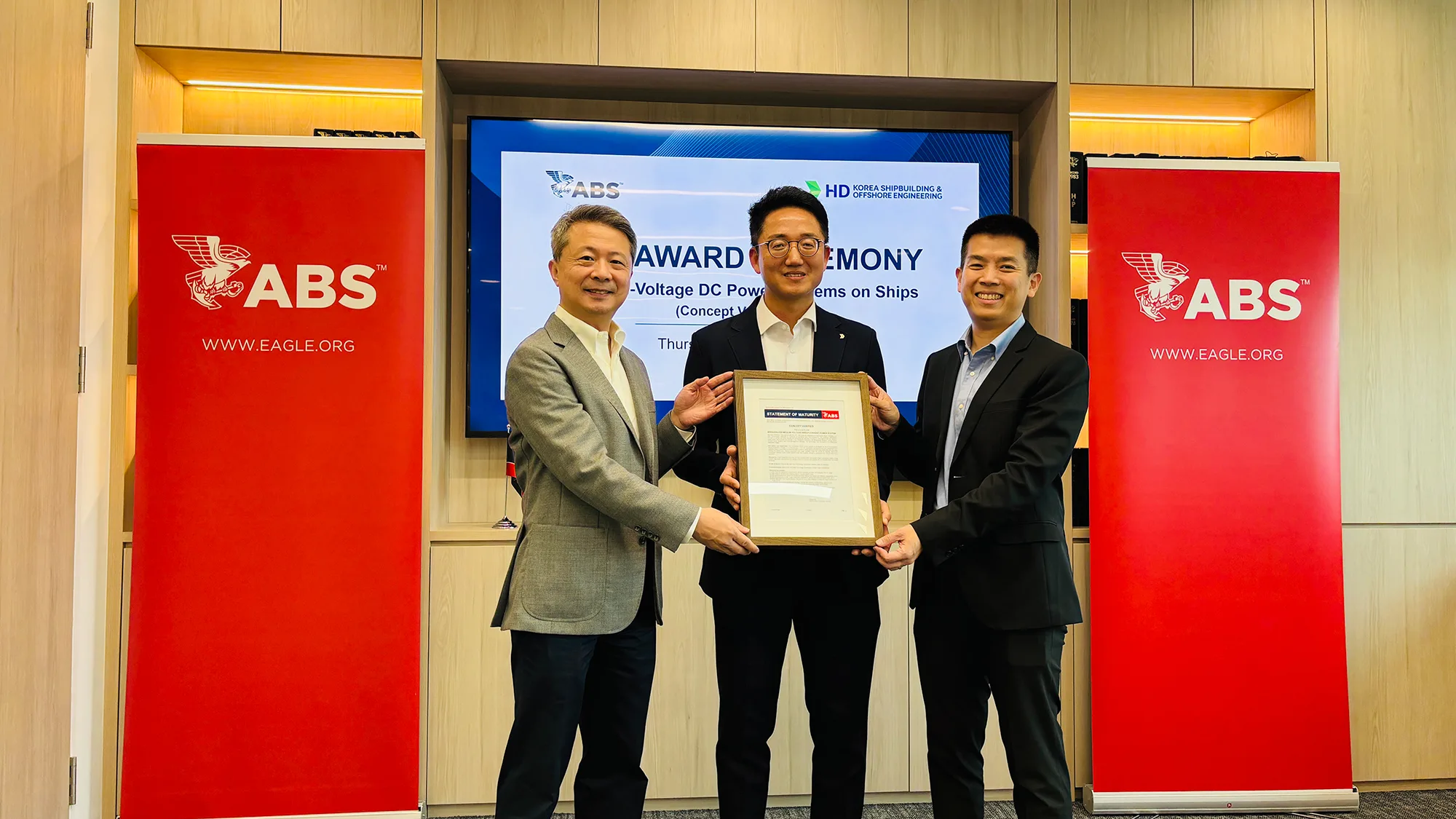
The American Bureau of Shipping (ABS) has recognised HD Korea Shipbuilding & Offshore Engineering (HD KSOE) and HD Hyundai Heavy Industries (HHI) for completing the Concept Verification stage of New Technology Qualification (NTQ) for a breakerless medium-voltage direct current (MVDC) power system.
The technology is being developed for large commercial vessels requiring approximately 30 MW of electrical power. It is intended to support higher-capacity electrical distribution as the power requirements of commercial ships increase, while providing a potential route to improved energy efficiency.
The breakerless architecture incorporates advanced control and fault-management capabilities designed to support the safety and resilience of onboard power distribution. Unlike conventional arrangements that rely on circuit breakers for fault isolation, the system is being developed around an alternative electrical protection and control architecture.
Development moves toward prototype validation
The latest milestone follows the completion of the technology’s Feasibility Stage in 2025. Development began under a joint project launched in 2024 to investigate the application of MVDC power systems aboard ships.
With Concept Verification completed, the project is progressing toward Prototype Validation, the next stage in the qualification process.
The achievement represents progress in the assessment of the technology’s design concept rather than confirmation of full operational validation or commercial deployment.
Patrick Ryan, Senior Vice President and Chief Technology Officer at ABS, said the increasing electrical requirements of large vessels are creating opportunities for higher-capacity distribution technologies.
“Large vessels are asking more of their power systems, and MVDC offers a promising route to higher efficiency and greater capacity,” said Ryan.
He added that the collaboration with HD KSOE and HHI would also support the development of ABS technical guidance for marine MVDC applications.
Sang-Hyun Kim, Senior Vice President of the Electrification Center at HD KSOE, identified the completion of Concept Verification as the next step following the earlier feasibility assessment.
Kim said the companies would continue developing the breakerless technology as the project advances toward prototype validation, with a focus on safe, high-power electrification.
Supporting higher-capacity marine electrification
Medium-voltage DC distribution is being investigated as an option for ships with substantial electrical power requirements, including vessels incorporating increasingly complex electrical equipment and propulsion-related systems.
The HD Hyundai project focuses on a breakerless configuration intended to combine high-capacity power distribution with integrated control and fault-management functions.
According to the companies, the proposed system is designed to help vessel operators maximise energy efficiency while accommodating the growing electrical demands of large commercial ships.
However, the Concept Verification milestone does not establish that the system has achieved particular efficiency savings in commercial operation. Further validation remains necessary before its operational performance can be assessed.
ABS continues to work with shipbuilders and technology developers on the technical frameworks required to evaluate emerging marine electrification technologies.
The latest qualification milestone advances the HD Hyundai MVDC development programme while leaving prototype validation and any subsequent commercial application as future stages.