Japanese shipping companies advance ammonia-fueled car carrier project
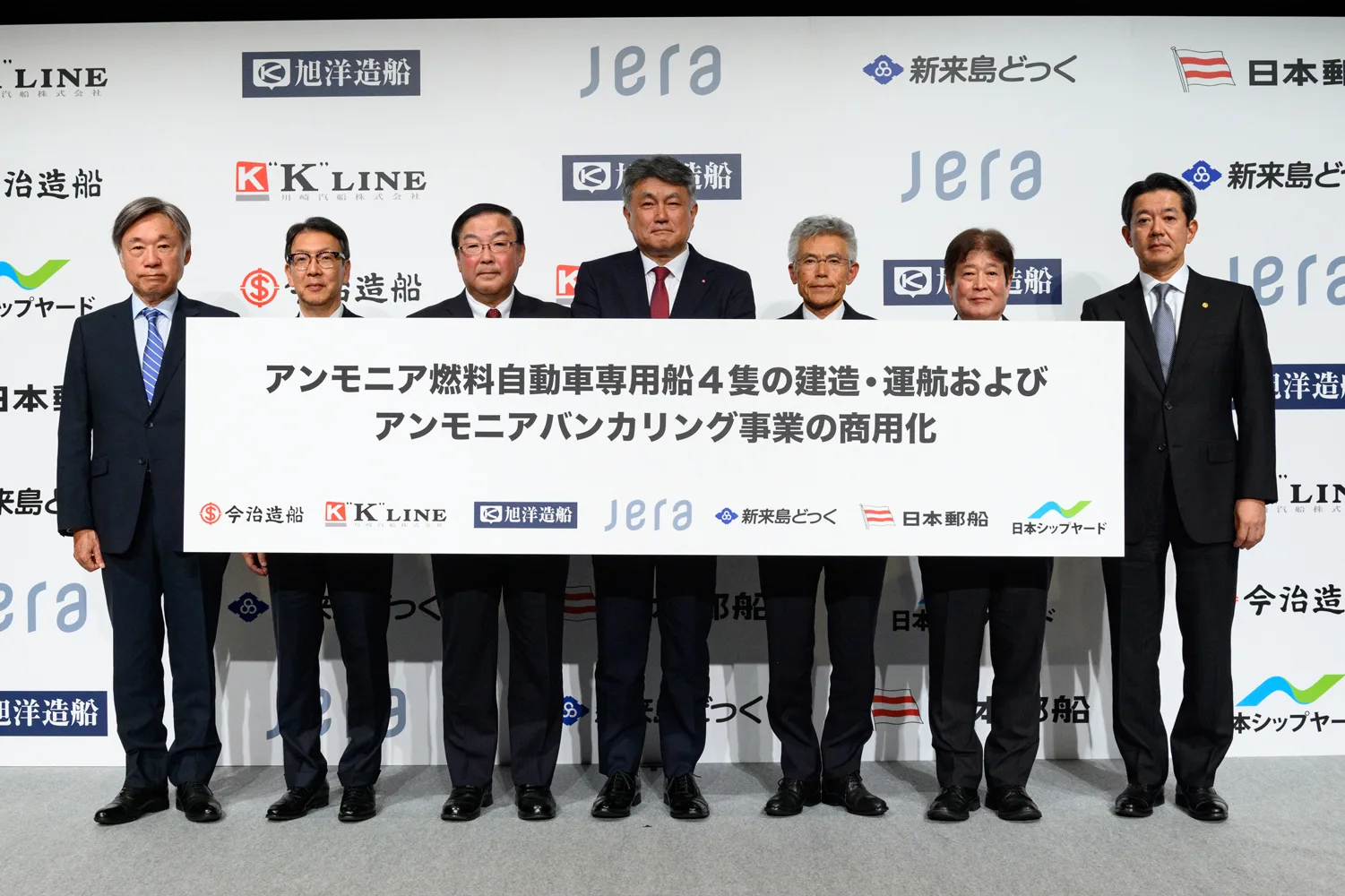
Seven Japanese companies have announced a joint initiative to build and operate four ammonia-fueled car carriers and establish an integrated marine fuel supply chain in Japan’s Chubu region.
The project brings together Imabari Shipbuilding, Kawasaki Kisen Kaisha (“K” LINE), Kyokuyo Shipyard, JERA, Shin Kurushima Dockyard, Nippon Yusen Kabushiki Kaisha (NYK) and Nihon Shipyard (NSY). Their cooperation covers green ammonia procurement, fuel loading infrastructure, a dedicated bunkering vessel and the construction and operation of the four car carriers.
The participating companies describe the initiative as the world’s first commercial project integrating ammonia fuel procurement, supply infrastructure and vessel operations within a single regional supply chain.
Four ammonia-fueled car carriers planned for 2030
Under the agreement, “K” LINE and NYK will each introduce two ammonia-fueled car carriers, bringing the combined fleet to four vessels. Completion is scheduled for 2030, after which the ships are expected to transport finished vehicles for customers including Toyota Motor Corporation.
The vessels will be equipped with dual-fuel engines capable of operating on ammonia. Their fuel tanks will be designed with sufficient capacity to enable trans-Pacific voyages using ammonia fuel alone.
Shin Kurushima Dockyard will lead the basic design phase, while Shin Kurushima Dockyard, Imabari Shipbuilding and Nihon Shipyard will jointly undertake the design and construction of the vessels.
The companies said the ships will incorporate multiple safety systems to address ammonia’s toxicity and corrosiveness, including leak prevention, detection and neutralisation measures.
Dedicated bunkering infrastructure in Chubu
JERA will be responsible for procuring green ammonia produced using renewable energy, with potential supply sources including India.
The energy company will also develop ship-loading facilities at the ammonia receiving terminal adjacent to its Hekinan Thermal Power Station. These facilities will support the transfer of ammonia to a dedicated bunkering vessel.
Kyokuyo Shipyard will construct the bunkering vessel, which is also scheduled for completion in 2030. The vessel will subsequently be owned and operated by NYK or one of its wholly owned subsidiaries.
In parallel, “K” LINE and NYK will establish an equally owned joint venture responsible for ammonia fuel sales and supply. The joint venture will use ship-to-ship bunkering to supply ammonia to the new car carriers, primarily at the ports of Nagoya and Mikawa.
The companies intend to draw on their experience handling ammonia and LNG to develop the operational procedures and safety arrangements required for commercial fuel supply.
Developing an integrated marine fuel supply chain
The initiative aims to connect fuel production and procurement with the infrastructure and vessel operations required to support ammonia as an alternative marine fuel.
Ammonia does not release carbon dioxide during combustion, although its overall environmental performance depends on how the fuel is produced and handled. The project will therefore focus on green ammonia manufactured using renewable energy.
The seven companies expect the development of dedicated supply infrastructure to support the introduction of ammonia-powered vessels while helping shipping customers address emissions associated with their transport activities.
With the car carriers and bunkering vessel targeted for completion in 2030, the project represents a coordinated effort to establish the infrastructure needed for commercial ammonia-fueled vehicle transportation.