Germany brings fourth floating LNG terminal into operation at Stade
Germany has brought its fourth federally commissioned floating LNG import terminal into operation at Stade, completing a programme of four terminals developed in less than four years to diversify the country’s natural gas import infrastructure.
Deutsche Energy Terminal (DET), the state-owned operator, confirmed the commissioning on 16 November 2026. The Stade facility joins two floating LNG terminals in Wilhelmshaven and one in Brunsbüttel, completing the initial development programme undertaken on behalf of the German federal government.
The new terminal is centred on the floating storage and regasification unit (FSRU) Energos Force, which receives LNG from visiting carriers, converts it back into gaseous form and supplies it to the German gas transmission network.
Energos Force expands Germany’s LNG import capacity
The Energos Force was built in 2021 and measures 294 metres in length, with a deadweight of 94,361 tonnes. According to DET, the vessel can regasify up to 500 million standard cubic feet of gas per day during winter using a closed-loop system with steam boilers.
During summer, under suitable operating conditions, its open-loop system using water from the River Elbe can achieve a regasification capacity of up to 750 million standard cubic feet per day.
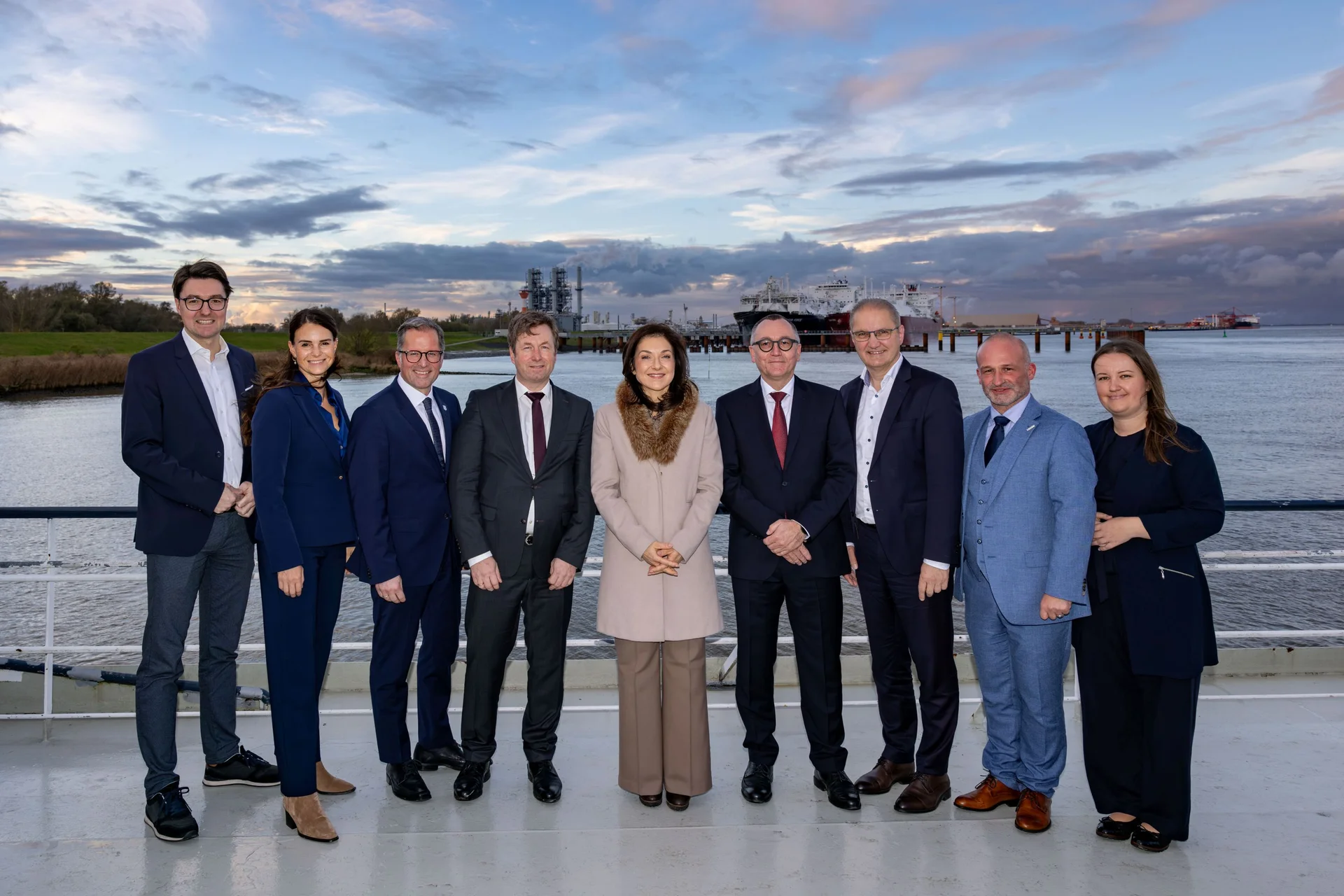
Speaking at the commissioning event, Germany’s Federal Minister for Economic Affairs and Energy, Katherina Reiche, said the new facility would provide an additional LNG import route during the coming winter. She indicated that Stade could feed up to 3.2 billion cubic metres of natural gas into Germany’s transmission network in 2027.
The commissioning follows the development of the terminal’s marine and gas infrastructure, with Niedersachsen Ports responsible for the berth and Gasfin Development, working with Worley, involved in completing the gas facilities.
Lower Saxony’s Minister-President Olaf Lies also highlighted the role of Stade in strengthening the country’s energy infrastructure and reducing dependence on individual gas supply routes.
DET completes four-terminal development programme
The completion of Stade marks the end of DET’s initial phase of developing four floating LNG import terminals. The company will now concentrate on the commercial allocation of regasification capacity and the continued operation of the facilities.
DET expects its terminals to feed at least 98.8 TWh of energy into the German gas network during 2026, equivalent to approximately 8.67 billion cubic metres of natural gas.
Peter Röttgen, CEO of DET, described the development of four floating LNG terminals within four years as a substantial undertaking involving multiple public authorities, infrastructure companies and project partners.
With the Stade facility now commissioned, Germany has completed the federally commissioned floating LNG terminal programme, adding another receiving point for LNG shipments and associated regasification capacity to its existing import infrastructure.