K Line reports higher earnings as container shipping and dry bulk strengthen
Kawasaki Kisen Kaisha (“K” Line) reported a sharp increase in earnings for the first half of its 2026 financial year, supported by stronger container shipping profitability, favourable dry bulk market conditions and gains from vessel disposals.
The Japanese shipping group recorded net income attributable to shareholders of ¥124.5 billion for the six months ended 30 September 2026, compared with ¥68.6 billion in the corresponding period last year. Operating revenue increased to ¥602 billion from ¥500.5 billion, while operating income rose to ¥51.2 billion from ¥42.9 billion.
Ordinary income nearly doubled to ¥118.3 billion from ¥59.6 billion, primarily reflecting higher equity-method earnings from Ocean Network Express (ONE). K Line also recognised extraordinary income, including gains from the sale of owned vessels, which contributed to its overall net profit.
During the July–September quarter alone, the company generated revenue of ¥315.1 billion and net income of ¥101.1 billion. Ordinary income reached ¥94.3 billion, while operating income stood at ¥31.6 billion.
The earnings improvement came despite higher operating costs, including an increase in bunker prices linked to the situation in the Middle East. The group’s average bunker price for the first half reached US$788 per metric tonne, compared with US$547 a year earlier.
Container shipping and dry bulk drive performance
K Line’s containership business recorded ordinary income of ¥74.4 billion in the first half, compared with ¥22.1 billion in the same period of FY2025. The increase reflected stronger earnings from ONE, as higher short-term freight rates and tighter vessel supply-demand conditions supported container shipping profitability.
The company attributed the improved market environment partly to disruptions associated with the Middle East situation and continued port congestion. Despite rising bunker and other operating costs, the containership business benefited from the stronger freight rate environment.
Dry bulk shipping also delivered a substantial improvement, with ordinary income rising to ¥16 billion from ¥1.3 billion a year earlier. Revenue increased to ¥189.5 billion from ¥144.3 billion, supported by firm demand across Capesize, Panamax and smaller vessel segments, alongside foreign exchange effects.
By contrast, the energy resource transport business recorded ordinary income of ¥4.8 billion, down from ¥5.4 billion. Although tanker and LPG carrier market conditions remained firm, the comparison was affected by the absence of a one-off gain recognised in the previous year.
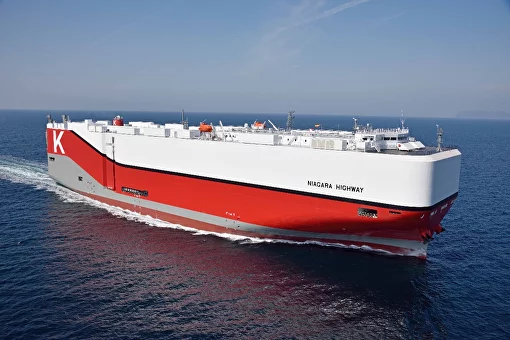
The car carrier business experienced a more pronounced decline in profitability. Ordinary income fell to ¥15.3 billion from ¥30.1 billion, reflecting lower fleet utilisation and higher operating costs associated with developments in the Middle East, particularly increased bunker expenses.
Annual outlook and shareholder returns
K Line maintained its latest FY2026 earnings forecast, which had been revised on 23 October 2026. The company expects full-year operating revenue of ¥1.17 trillion and net income attributable to shareholders of ¥190 billion, compared with ¥1.018 trillion and ¥132.9 billion respectively in FY2025.
Ordinary income is also forecast to reach ¥190 billion, supported by stronger container shipping earnings and resilient dry bulk market conditions. The company expects its containership business to generate ordinary income of ¥107 billion for the full year, compared with ¥24 billion in FY2025.
The outlook incorporates assumptions regarding continuing disruption in the Middle East. K Line expects conditions in the Strait of Hormuz to normalise toward the end of March 2027, with passage resuming from April, while its full-year forecast generally assumes continued routing via the Cape of Good Hope rather than the Suez Canal. The company noted separately that ONE plans to resume Suez Canal transits on certain routes.
K Line also maintained its annual dividend forecast of ¥120 per share, comprising interim and year-end distributions of ¥60 each.
The group completed a share repurchase programme involving 44,429,000 shares for ¥122.5 billion, with the repurchased shares cancelled on 2 October 2026. The programme forms part of its broader capital allocation strategy, which balances investment, financial stability and shareholder returns.
As of 30 September 2026, K Line’s fleet comprised 439 vessels, compared with 440 at the end of March. The fleet included 165 dry bulk carriers, 54 LNG carriers, 99 car carriers and 36 containerships, alongside tankers and other specialised vessels.
The company continues to monitor geopolitical developments, freight market conditions and rising operating costs as it implements the final year of its current medium-term management plan.