DSV and Cathay Cargo sign three-year sustainable aviation fuel agreement
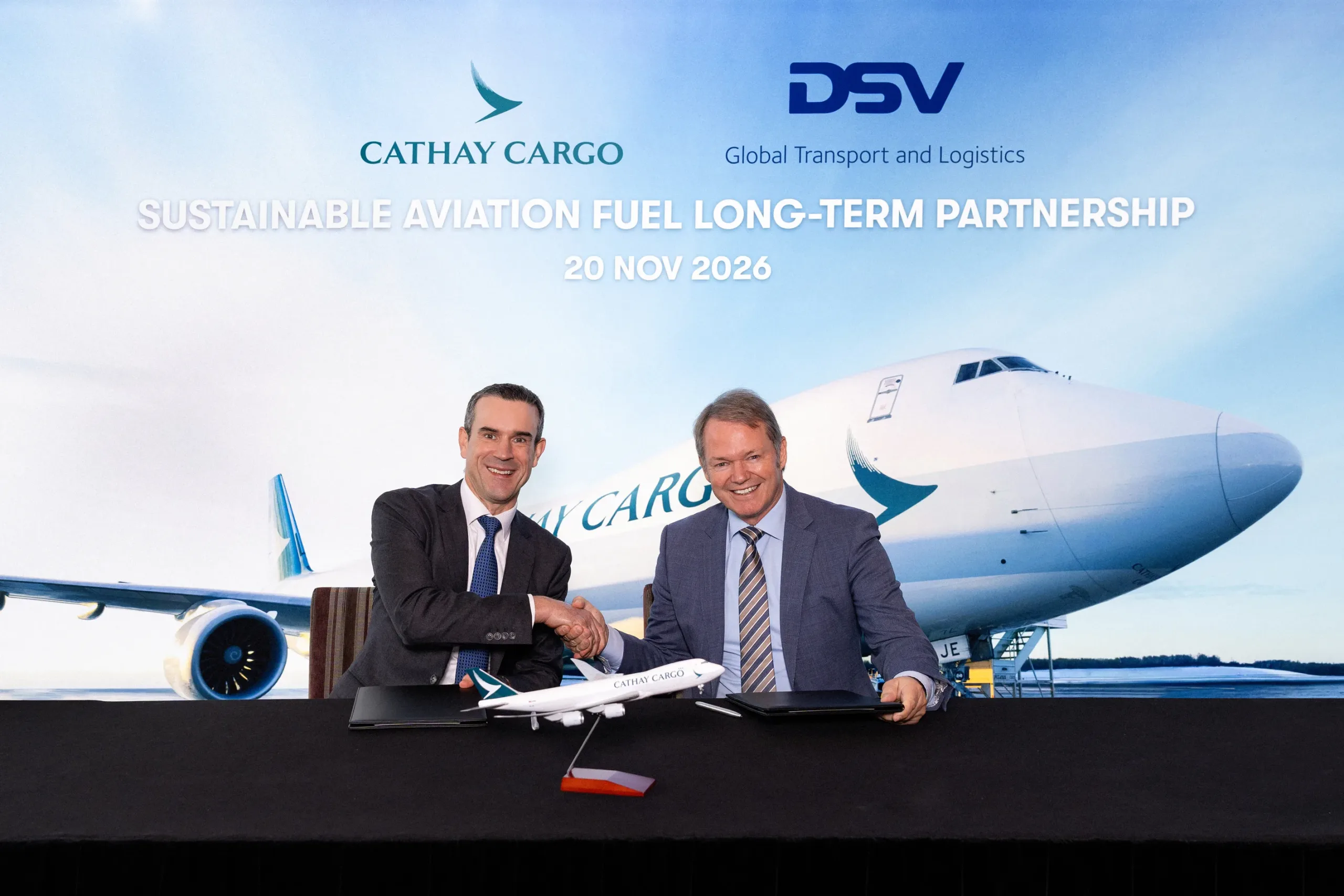
DSV and Cathay Cargo have entered into a three-year agreement covering 4.5 million US gallons of sustainable aviation fuel (SAF) produced in Asia, establishing a long-term commitment aimed at expanding regional fuel supply and reducing emissions associated with air freight.
The agreement, announced on 24 November 2026, covers approximately 13,155 tonnes of SAF and is expected to support reductions of at least 45,000 tonnes of carbon dioxide equivalent (CO₂e) emissions.
It marks the first long-term SAF partnership between the two companies and makes Cathay Cargo DSV’s first airline partner from Asia under such an arrangement to expand the use of sustainable aviation fuel across its regional network.
Three-year agreement supports Asian SAF production
Under the agreement, all SAF covered by the partnership will be sourced from Asia, creating a longer-term demand commitment for producers and suppliers in the region.
DSV and Cathay Cargo intend to use the arrangement to support greater availability of SAF as the aviation and logistics industries seek alternatives to conventional jet fuel.
For air freight operators, access to SAF remains an important consideration in reducing lifecycle greenhouse gas emissions, although production volumes and regional availability continue to constrain wider adoption.
“This partnership creates long-term demand for SAF produced in Asia. It supports the regional production and supply needed to scale its use,” said Stefan Krikken, Senior Vice President, Global Air Product at DSV.
The agreement builds on an established commercial relationship between the two companies and their previous participation in SAF initiatives.
Emissions reductions to be allocated through Cathay programme
The partnership forms part of Cathay’s Corporate Sustainable Aviation Fuel Programme, in which DSV has participated as a Diamond member.
Under the programme, verified emissions reductions associated with SAF use can be allocated to participating companies independently of the location where the fuel is physically used.
This arrangement allows DSV to account for qualifying emissions reductions associated with its air freight activities without requiring the corresponding SAF to be supplied directly to every aircraft transporting its customers’ shipments.
Cathay Cargo will provide documentation covering the fuel’s journey from sourcing through to uplift, supporting the verification and allocation of the associated environmental benefits.
The companies estimate that the three-year agreement will support at least 45,000 tonnes of CO₂e reductions. This figure represents an expected outcome rather than emissions reductions already achieved.
“Scaling SAF requires collaboration across the aviation and logistics value chain, and this multi-year commitment reflects our shared vision to support its wider adoption,” said Dominic Perret, Director Cargo at Cathay.
DSV expands sustainable air freight initiatives
The agreement adds to DSV’s ongoing efforts to develop lower-emission solutions for international air freight.
Earlier in November, DSV announced a separate SAF pilot agreement with Google Cloud, covering up to 2.5 million US gallons of fuel and targeting 25,000 tonnes of lifecycle greenhouse gas emissions reductions associated with the technology company’s shipments.
The Cathay Cargo arrangement differs in its three-year duration and specific commitment to SAF produced in Asia.
Through its collaboration with Cathay Cargo, DSV aims to strengthen demand for renewable aviation fuel while supporting the development of regional supply chains.
The companies have not disclosed the financial value of the agreement, the individual SAF producers involved or a detailed schedule for fuel deliveries.
The partnership establishes a multi-year framework for SAF procurement and the allocation of associated environmental benefits, reflecting the growing role of logistics providers and cargo airlines in supporting alternative aviation fuel markets.