NYK and seven partners develop remote ship emissions monitoring technology
NYK Line and seven Japanese organisations have signed an agreement to advance the development of technology capable of measuring greenhouse gas (GHG) emissions from ships remotely, without requiring physical contact with the vessels.
The agreement, signed on 25 November 2026, will support the development of True Emission Eye – Maritime, a project that aims to measure and quantify vessel emissions using optical observation technology.
The Port of Yokohama will serve as the main demonstration location, where measurements on actual vessels will be used to assess the technology’s accuracy and examine potential applications in commercial shipping and port operations.
The eight participants are NYK Line, MUFG Bank, Nagoya Electric Works, ArkEdge Space, Shimizu Corporation, the City of Yokohama, Yokohama-Kawasaki International Port Corporation and Yokohama Port Corporation.
Remote sensing technology tested on actual vessels
The project aims to complement conventional methods of calculating vessel greenhouse gas emissions, which primarily rely on fuel consumption and fuel characteristics.
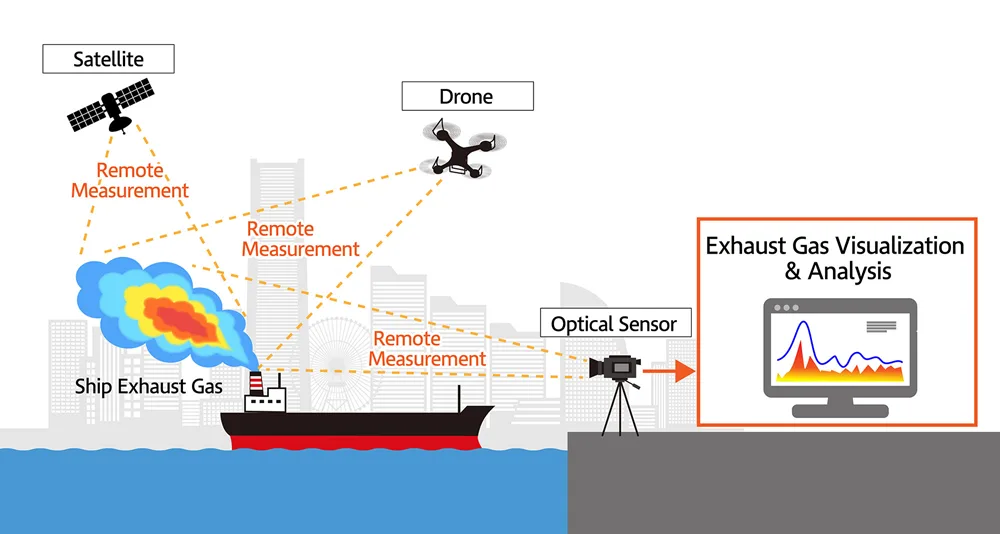
Instead of estimating emissions solely through operational data, the proposed system uses optical observation technology to detect gases emitted by ships from a distance.
The approach is based on the ability of gases, including carbon dioxide, to absorb and emit light at specific wavelengths.
Data obtained from optical observations of vessel exhaust is combined with additional information, including the distance to the vessel and prevailing weather conditions, to calculate emissions.
According to NYK, the project has already conducted tests at experimental facilities and measurements involving the company’s vessels, both while berthed and underway.
At Yokohama Port, infrared images of ship exhaust have been captured from locations including Osanbashi Pier and the Yokohama Bay Bridge Skywalk.
Researchers are comparing the observations with vessel operating data to evaluate the accuracy of the measurement and analysis methods.
Yokohama Port to support further development
Under the new collaboration agreement, the eight organisations will continue conducting measurements on vessels operating in and around Yokohama Port.
The next phase will focus on testing the system under different operating and environmental conditions, improving measurement accuracy and assessing the technical specifications required for potential practical applications.
The partners will also examine the feasibility of establishing fixed observation points at ports, which could provide a way to monitor vessel emissions without relying exclusively on information reported by ship operators.
Such systems could eventually supplement existing emissions reporting and verification arrangements, although the technology remains under development.
The agreement does not establish a commercial monitoring service or confirm that the technology has reached the level of accuracy required for regulatory use.
Satellite monitoring among future possibilities
The project will also investigate the technical requirements for measuring ship emissions from satellites and the potential integration of space-based observations with data collected from the ground.
ArkEdge Space, one of the participating organisations, specialises in small satellite technology and space-based services.
Future observation systems could potentially combine monitoring from ports, drones and satellites to provide wider geographical coverage of maritime emissions.
However, satellite-based emissions monitoring remains a development objective rather than an operational capability announced under the agreement.
The partners intend to examine whether the technology could improve the transparency and objectivity of emissions assessments, including the measurement of individual vessels’ environmental performance.
The organisations have not disclosed the project’s financial value, a timetable for commercial deployment or quantified accuracy results from the trials conducted so far.
The agreement establishes a framework for progressing from experimental and vessel-based measurements towards potential practical applications in shipping and port operations.
If successfully developed and validated, the technology could provide an additional method for assessing maritime greenhouse gas emissions independently of conventional fuel-based calculations.